


Optibumin® 20 – Recombinant human albumin
High purity, low lipid recombinant albumin solution

Name | Price | Qty | |
|---|---|---|---|
$1,660.00
|
|||
$14,800.00
|
Product Description
Optibumin® 20 is a high-purity recombinant human serum albumin (rHSA) supplied as a sterile 20% (w/v) liquid for biopharmaceutical formulation, drug conjugation, stem cell culture, and assisted reproductive technology applications. Produced using InVitria's animal-free ExpressTec expression platform at an ISO 9001:2015-certified, cGMP-compliant facility in Junction City, Kansas, Optibumin 20 is part of InVitria's Optibumin line of high-performance recombinant albumins.
Like Optibumin 25, Optibumin 20 delivers measurably superior performance compared to plasma-derived HSA: approximately 3x higher drug binding affinity, approximately 3x higher maleimide conjugation efficiency, and approximately 10x tighter lot-to-lot consistency across critical quality attributes. These performance advantages reflect a stabilizer-free, aggregate-depleted, native-state molecule with ≥99.0% purity — the highest purity available in the rHSA market — and approximately 99% reduced Cys34 thiol versus ~60% in plasma HSA.
For most cell and gene therapy manufacturing workflows, cryopreservation, and closed-system biomanufacturing applications, Optibumin 25 is InVitria's recommended rHSA. Optibumin 20 is appropriate for applications where a 20% (w/v) liquid albumin in bottles fits specific formulation or process requirements — including select drug conjugation workflows, IVF and assisted reproduction applications, and biopharmaceutical formulation use cases where 20% concentration is the target. Contact InVitria to discuss the best option for your specific application.
Ready to try Optibumin 20?
Advantages
Purity and Defined Composition
- ≥99.0% purity — the highest purity available in the rHSA market
- Endotoxin level ≤0.02 EU/mg
- Approximately 99% reduced Cys34 thiol — essential for controlled maleimide conjugation and drug binding (vs. ~60% reduced Cys34 in plasma-derived HSA)
- Ultra-low lipid content — supporting drug solubilization, hydrophobic drug delivery, and embryo culture applications
- No added preservatives, no sodium octanoate, no N-acetyl tryptophan — unlike plasma-derived HSA, which requires stabilizers to survive pasteurization
- 100% animal-origin-free and blood-free — eliminates risks of adventitious viral, prion, and bacterial pathogens associated with plasma sourcing
Performance in Cell and Gene Therapy Manufacturing
- Enables up to 40% DMSO reduction in cryopreservation while maintaining CAR-T memory phenotypes (Tscm, Tcm) post-thaw (see T cell cryopreservation application note)
- Validated in primary T cell wash applications with >80% cell retention and <5% viability change post-wash (see T cell wash data)
- Preserves lentiviral titer during sterile filtration — a common loss point in viral vector manufacturing (see lentiviral filtration study)
- Supports iPSC cryopreservation with enhanced viability, expansion, and pluripotency preservation (see iPSC cryopreservation data)
Measurably Superior Performance vs. Plasma-Derived HSA
- Approximately 3x higher drug binding affinity at Sudlow site I (KD 2.58 µM vs. 7.45 µM; p < 0.01), demonstrated in head-to-head warfarin binding studies with the Optibumin platform (see analytical characterization data)
- Approximately 3x higher maleimide conjugation efficiency, enabling defined-stoichiometry bioconjugation for ADC development (see conjugation study)
- Approximately 10x tighter lot-to-lot consistency across aggregate content, Cys34 redox state, and other critical quality attributes (standard deviation of aggregate fraction 0.20% vs. 3.57% for plasma HSA; F-test p < 0.0001)
- Preserved lentiviral titer during sterile filtration — a common loss point in viral vector manufacturing (see lentiviral filtration study)
Supply Chain Reliability and Manufacturing Control
- End-to-end vertically integrated US-based manufacturing at InVitria's ISO 9001:2015-certified, cGMP-compliant facility in Junction City, Kansas
- Consistent lot-to-lot performance enabled by recombinant expression, not donor-dependent sourcing
- Scalable to metric-ton production volumes without supply constraints from blood donation availability
- 3-year shelf life when stored at 2–8°C
20% Liquid Format for Drug Conjugation, Formulation, and IVF Applications
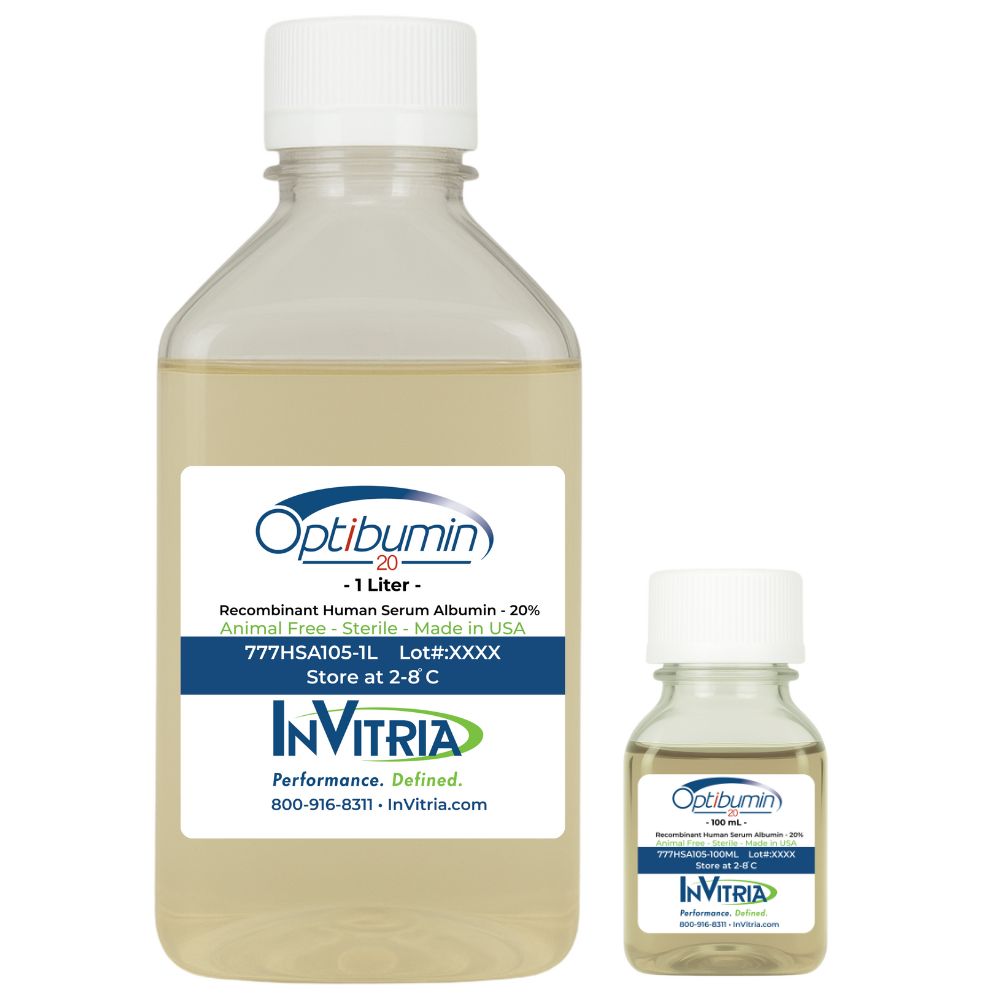
- Supplied as a sterile, ready-to-use 20% (w/v) liquid solution in 100 mL and 1 L bottles — eliminating the need for reconstitution
- Concentration appropriate for drug conjugation chemistry and select biopharmaceutical formulation workflows
- Ultra-low lipid content suitable for embryo culture and assisted reproductive technology protocols
Applications
Drug Conjugation and Bioconjugation Optibumin 20 is well-suited for antibody-drug conjugate (ADC) and other maleimide-based bioconjugation chemistry, where its approximately 99% reduced Cys34 thiol (vs. ~60% in plasma HSA) and approximately 3x higher maleimide conjugation efficiency support defined-stoichiometry conjugation and predictable drug-to-albumin ratios (see covalent conjugation study). The 20% (w/v) concentration fits conjugation workflows where formulation volumes and target albumin doses align with this concentration range.
Drug Solubilization and Hydrophobic Drug Delivery Albumin's high binding capacity for hydrophobic drugs — including two primary Sudlow sites, drug binding site III, and seven fatty acid binding sites — makes it an effective carrier for drugs that would otherwise require toxic organic solvents. Optibumin 20's ultra-low lipid content, stabilizer-free composition, and aggregate-depleted structure maximize the accessible binding capacity, making it particularly well-suited for formulating poorly soluble small-molecule drugs, cytokines, and hydrophobic therapeutic payloads (see cytokine recovery and stability data).
Biopharmaceutical Formulation Optibumin 20 stabilizes therapeutic proteins, monoclonal antibodies, and drug products in formulation applications where a 20% (w/v) liquid albumin is the appropriate concentration. Its stabilizer-free composition (no sodium octanoate, no N-acetyl tryptophan) and aggregate-depleted structure support protein stability without the interference observed with plasma-derived HSA stabilizers. Optibumin 20 reduces aggregation, prevents surface adsorption, and maintains protein activity in both liquid and lyophilized formulations.
In Vitro Fertilization and Assisted Reproduction Optibumin 20's ultra-low lipid content, chemically defined composition, and absence of stabilizers make it well-suited for embryo culture and assisted reproductive technology protocols. Its animal-origin-free profile eliminates the pathogen transmission concerns associated with serum-derived albumin traditionally used in IVF media, while delivering the consistent performance required for reproductive medicine research and clinical applications.
Stem Cell Research and Expansion Optibumin 20 supports iPSC, MSC, and other stem cell culture workflows where a 20% liquid albumin is appropriate, providing a chemically defined, animal-origin-free alternative to plasma-derived and serum-derived albumin. Its consistent lot-to-lot performance eliminates the variability that complicates stem cell research when using blood-sourced materials.
Cell Therapy Manufacturing For cell therapy manufacturing workflows — including CAR-T, TIL, cryopreservation, and closed-system biomanufacturing — Optibumin 25 is InVitria's recommended rHSA. Optibumin 25's 25% (w/v) liquid format matches plasma-derived HSA concentration, and its availability in closed-system bags with weldable tubing supports sterile cell therapy workflows. Contact InVitria to discuss whether Optibumin 20 or Optibumin 25 fits your specific application.
Lentiviral Vector Manufacturing (CAR-T and Gene Therapy) Lentiviral vectors are notoriously fragile, with the lipid envelope vulnerable to shear, transmembrane pressure, and surface adsorption losses across every downstream unit operation — and final 0.22 µm sterile filtration is a particular pain point, with published losses exceeding 30% of infectious titer. In a recent InVitria application note (Stathos et al., 2026), pre-coating 0.22 µm PES filters with 1% (m/v) Optibumin 25 for just 5 minutes preserved approximately 75% of genomic titer (vs. 19% without Optibumin) and approximately 49% of infectious titer (vs. 17% without) — an approximately 3-fold increase in retained infectious titer. The protective mechanism combines shear protection, prevention of viral particle aggregation, and non-specific surface coating that reduces lentiviral adsorption to the filter membrane. Optibumin 25's excipient status — anchored by regulatory precedent in Merck's ERVEBO Ebola vaccine, which uses InVitria's recombinant albumin to stabilize VSV-G pseudotyped envelope virus — makes it suitable for both ex vivo CAR-T manufacturing and the emerging class of in vivo CAR-T therapies where lentiviral vector quality, consistency, and animal-origin-free regulatory profile are gating requirements. Applied at industrial scale, the 3-fold titer recovery improvement could translate into substantial cost-of-goods savings — published lentivirus production costs run approximately $100,000 per CAR-T dose in early clinical trials, meaning Optibumin 25 pre-treatment could reduce per-dose costs by an estimated $67,000.
Optibumin 20 Technical Specifications
Key specifications for Optibumin 20 as supplied — including purity, endotoxin, formulation, storage, and manufacturing standards. Full Certificate of Analysis available upon request.| Specification | Details |
|---|---|
| Product Name | Optibumin® 20 |
| Brand | InVitria® |
| Catalog Number | 777HSA105 |
| Protein | Recombinant Human Serum Albumin (rHSA) |
| Class | Serum Protein / Albumin — Excipient Grade |
| Synonyms | rHSA, HSA, ALB, Albumin, Human Albumin, SA, rHA |
| Expression System | Recombinant, rice-based expression system |
| Molecular Weight | ~66.5 kDa |
| Purity | ≥ 99.0% |
| Endotoxin Level | ≤ 0.02 EU/mg |
| Formulation | Sterile 20% w/v (200 mg/mL) liquid |
| Concentration | 200 mg/mL (20% w/v) |
| Appearance | Slightly yellow/amber solution |
| Carrier Protein / Stabilizer | None (no additives or preservatives) |
| Sterility | Sterile (0.2 µm sterile filtered) |
| Packaging | 100 mL and 1 L bottles |
| Storage Conditions | 2–8 °C |
| Shelf Life | 3 years |
| Animal-Origin-Free | Yes |
| Production Standard | ISO 9001:2015, cGMP-compliant facility |
| Country of Origin | USA (Junction City, KS) |
Why Select Optibumin 20 Over Plasma-Derived Albumin?
| Key Attribute | Optibumin 20 (rHSA) | Plasma-derived Albumin (pHSA) |
|---|---|---|
| PERFORMANCE VS. PLASMA HSA | ||
| Drug binding affinity at Sudlow site I | ✅ ~3x higher (KD 2.58 µM vs. 7.45 µM, warfarin) | Baseline |
| Maleimide conjugation efficiency | ✅ ~3x higher | Baseline |
| Cys34 reduced thiol (preserved for bioconjugation) | ✅ ~99% reduced | ❌ Typically ~60% reduced (~40% cysteinylated) |
| Suitable for defined-stoichiometry bioconjugation | ✅ Yes (high Cys34 preservation) | ❌ Variable (high cysteinylation) |
| Aggregate burden (total aggregates) | ✅ <0.5% | ❌ Typically ~3–5%, varies by supplier |
| SAFETY PROFILE | ||
| Recombinant production | ✅ Yes | ❌ No (plasma-derived) |
| Animal-origin-free | ✅ Yes | ❌ Blood-derived |
| Blood-free | ✅ Yes | ❌ Blood-derived |
| Free of adventitious agent risk | ✅ Yes | ❌ Adventitious agent risk present |
| No donor variability | ✅ Yes | ❌ Donor-pool variability |
| TSE/BSE risk | ✅ None (no animal source) | ⚠️ Depends on donor screening |
| FORMULATION ADDITIVES | ||
| Added preservatives | ✅ No | ❌ Typically contains preservatives, (sodium azide, sodium benzoate, potassium sorbate) |
| Added stabilizers | ✅ No | ❌ Typically contains stabilizers (sodium octanoate, N-acetyl tryptophan) |
| LOT-TO-LOT CONSISTENCY | ||
| Consistent lot-to-lot performance | ✅ Yes — controlled recombinant production | ❌ Variable — source-dependent |
| Performance traceable to a single manufacturing process | ✅ Yes — ExpressTec platform | ❌ Multi-donor plasma pool |
| SUPPLY CHAIN AND SCALABILITY | ||
| Scalable production (metric-ton capacity) | ✅ Yes | ❌ Limited by plasma donor supply |
| Supply independent of blood donation | ✅ Yes | ❌ Dependent on donor supply |
| Scale-up partnership with customer programs | ✅ Yes — InVitria scales with customer programs from clinical through commercial | ❌ Typically not provided |
| Vertically integrated supply chain | ✅ Yes — InVitria owns the complete supply chain | ❌ Multiple intermediaries |
| Manufactured in United States | ✅ Yes — Junction City, Kansas | Varies by supplier |
| Supports animal-free and sustainable sourcing mandates | ✅ Yes | ❌ No |
| REGULATORY AND DOCUMENTATION SUPPORT | ||
| ISO 9001:2015 certified manufacturing | ✅ Yes | Varies by supplier |
| cGMP-compliant QMS (21 CFR 210/211) | ✅ Yes | Varies by supplier |
| Certificate of Origin | ✅ Available | Varies by supplier |
| Animal-Free Statement | ✅ Available | ❌ Not applicable |
| Regulatory support package | ✅ Yes — full dossier-quality documentation for IND and BLA submissions | ❌ Limited or supplier-dependent |
| Technical support for regulatory filings | ✅ Yes — InVitria technical team supports customer regulatory submissions | ❌ Not typically provided |
Optibumin 20 Frequently Asked Questions (FAQs)
Product Overview
What Is Optibumin 20?
Optibumin 20 is a chemically defined, animal-origin-free recombinant human serum albumin (rHSA) supplied as a sterile 20% (w/v) liquid in 100 mL and 1 L bottles. Optibumin 20 is part of InVitria's Optibumin line of high-performance recombinant albumins, sharing the same ExpressTec expression platform, ≥99.0% purity, stabilizer-free composition, and approximately 99% reduced Cys34 thiol as Optibumin 25.
What Is Optibumin 20 Made From?
Optibumin 20 is produced recombinantly using InVitria's ExpressTec expression platform, a non-mammalian, non-human expression host with no animal-derived, human-derived, or blood-derived materials. Manufacturing is fully animal-origin-free, from raw materials through production equipment to product-contact packaging. Optibumin 20 is manufactured without stabilizers (no sodium octanoate, no N-acetyl tryptophan) required for plasma-derived HSA pasteurization, enabling a native-state molecule without the harsh thermal treatment required to render plasma HSA safe for injection.
Regulatory and Quality
Is Optibumin 20 cGMP-Manufactured and Animal-Origin-Free?
Yes. InVitria manufactures Optibumin 20 under a cGMP-compliant Quality Management System (QMS) with respect to 21 CFR Part 210/211 at its ISO 9001:2015-certified facility in Junction City, Kansas, USA. Optibumin 20 is 100% animal-origin-free — raw materials, production host, manufacturing equipment, and product-contact packaging are all free of animal-derived components.
What Are the Purity and Endotoxin Specifications for Optibumin 20?
Optibumin 20 is supplied as a sterile 20% (w/v) liquid with purity ≥99.0%, endotoxin ≤0.02 EU/mg, and approximately 99% reduced Cys34 thiol — essential for maleimide-based bioconjugation and drug binding.
What Quality Documentation Is Available for Optibumin 20?
Optibumin 20 is supported by a Certificate of Analysis, Safety Data Sheet, Guidelines for Use, Certificate of Origin and Animal-Free / TSE-BSE Statement, ISO 9001 certificate, and cGMP Statement. Additional Quality and Regulatory documentation is available on request — including materials for IND-supporting packages and supplier qualification.
Does InVitria Provide a Drug Master File (DMF) or Equivalent Regulatory Documentation for Optibumin 20?
InVitria provides a product-specific Technical Summary for Optibumin 20 containing CMC-style documentation — including manufacturing process, raw material controls, characterization data, release specifications, and lot analysis — designed to support customer regulatory submissions globally, including IND, BLA, and comparable filings under FDA, EMA, and other regulatory authorities. Unlike a Drug Master File, the Technical Summary is provided directly to the customer for incorporation into their own regulatory documentation, giving customers full visibility into the CMC information and supporting global filings without being tied to a single regulatory pathway. The Optibumin 20 Technical Summary is supported by per-lot Certificates of Analysis, Animal-Origin-Free / TSE-BSE statements, ISO 9001 certification, cGMP statements, and change notification under defined policies. Contact us to request the Technical Summary.
Does Optibumin 20 Bind Drugs Better Than Plasma HSA?
Yes. The Optibumin platform demonstrates approximately 3x higher drug binding affinity at Sudlow site I compared to plasma-derived HSA (KD 2.58 µM vs. 7.45 µM; p < 0.01, Fisher's F-test), driven by the absence of stabilizers (sodium octanoate and N-acetyl tryptophan) that interfere with drug binding, approximately 10x fewer aggregates that preserve accessible surface area, and approximately 99% reduced Cys34 versus ~60% in plasma HSA. These advantages apply to both Optibumin 20 and Optibumin 25 because they characterize the rHSA molecule itself, not the product concentration.
How Efficient Is Maleimide Conjugation to Optibumin 20?
Optibumin 20 achieves approximately 3x higher maleimide conjugation efficiency compared to plasma-derived HSA. This reflects the preserved Cys34 thiol (99% reduced vs. ~60% for pHSA) and the absence of stabilizers that can interfere with conjugation chemistry, making Optibumin 20 well-suited for ADC development and other defined-stoichiometry bioconjugation applications.
Selection and Comparison
What Is the Difference Between Optibumin 20 and Optibumin 25?
Optibumin 20 and Optibumin 25 are both liquid recombinant human serum albumin (rHSA) products manufactured by InVitria using the same ExpressTec expression platform, sharing the same ≥99.0% purity specifications, stabilizer-free composition, approximately 99% reduced Cys34 thiol, and animal-origin-free profile. Optibumin 20 is a 20% (w/v) liquid supplied in 100 mL and 1 L bottles, appropriate for drug conjugation workflows, biopharmaceutical formulation applications where 20% concentration is the target, IVF and assisted reproduction, and select stem cell research workflows. Optibumin 25 is a 25% (w/v) liquid — the same concentration as plasma-derived human serum albumin — supplied in both bottles and closed-system bags with weldable tubing.
For cell and gene therapy manufacturing workflows — particularly closed-system workflows, cryopreservation, and applications where Optibumin is used as a direct alternative to 25% plasma-derived HSA — Optibumin 25 is InVitria's recommended product. For applications where a 20% liquid albumin in bottles is appropriate, Optibumin 20 is the correct product. Contact InVitria to discuss the best option for your specific application.
What Is the Difference Between Optibumin 20 and Exbumin?
Optibumin 20 and Exbumin are both recombinant human serum albumin (rHSA) products manufactured by InVitria using the same ExpressTec expression platform. Optibumin 20 is a high-purity (≥99.0%) liquid rHSA supplied as a 20% (w/v) solution in bottles, designed for drug conjugation, biopharmaceutical formulation, IVF, and select stem cell research applications. Exbumin is the excipient-grade rHSA with documented regulatory precedent in an approved injectable human biologic — it is a formulation component in Merck's ERVEBO Ebola vaccine and is approved as an excipient by the FDA, EMA, and PMDA. Exbumin is supplied as a lyophilized powder.
If you specifically require an rHSA with established regulatory precedent in an approved injectable human biologic, or if a lyophilized powder format is needed for your formulation or stability requirements, Exbumin is the correct product. For drug conjugation, formulation, or research applications where a 20% liquid albumin is appropriate, Optibumin 20 is the correct product. Contact InVitria to discuss the best option for your specific application.
What Is the Difference Between Optibumin 20 and Cellastim S?
Optibumin 20 is a liquid recombinant human serum albumin (rHSA) designed for drug conjugation, biopharmaceutical formulation, IVF, and stem cell research applications. Cellastim S is the cell culture-grade rHSA designed for serum-free media supplementation, with specifications appropriate for that application.
If you are supplementing cell culture media, Cellastim S is appropriate. If you are using rHSA in drug conjugation, formulation, or research applications where a 20% liquid albumin is appropriate, Optibumin 20 is the correct product.
How Is Optibumin 20 Different From Yeast-Derived Recombinant Albumins?
Yeast-derived recombinant albumins addressed the pathogen risk of plasma HSA but introduced new issues: immunogenic yeast host cell proteins requiring extensive purification, and surfactants like Polysorbate 80 added to prevent processing aggregation. Optibumin 20's non-mammalian, non-yeast ExpressTec expression system produces a native-state molecule without these constraints.
Application and Use
Can Optibumin 20 Be Used for Albumin-Drug Conjugates and ADCs?
Yes. Optibumin 20 is well-suited for ADC applications. Its approximately 99% reduced Cys34, approximately 3x higher maleimide conjugation efficiency versus plasma HSA, and absence of stabilizers make it an effective scaffold for defined-stoichiometry conjugation chemistry. The 20% (w/v) concentration fits conjugation workflows where formulation volumes and target albumin doses align with this concentration range.
Can Optibumin 20 Be Used for Drug Solubilization?
Yes. Albumin's high binding capacity for hydrophobic drugs — including two main Sudlow sites, drug binding site III, and seven fatty acid binding sites — makes it an effective carrier for drugs that would otherwise require toxic organic solvents. Optibumin 20's ultra-low lipid content, stabilizer-free composition, and aggregate-depleted structure maximize the accessible binding capacity.
Can Optibumin 20 Be Used in IVF and Assisted Reproduction?
Yes. Optibumin 20's ultra-low lipid content, chemically defined composition, and absence of stabilizers make it well-suited for embryo culture and assisted reproductive technology protocols. Its animal-origin-free profile eliminates the pathogen transmission concerns associated with serum-derived albumin traditionally used in IVF media, while delivering the consistent performance required for reproductive medicine research and clinical applications.
Can Optibumin 20 Be Used in Stem Cell Research?
Yes. Optibumin 20 supports iPSC, MSC, and other stem cell culture workflows where a 20% liquid albumin is appropriate, providing a chemically defined, animal-origin-free alternative to plasma-derived and serum-derived albumin. Its consistent lot-to-lot performance eliminates the variability that complicates stem cell research when using blood-sourced materials.
Packaging and Ordering
What Packaging Options Are Available for Optibumin 20?
Optibumin 20 is available as a sterile 20% (w/v) liquid in 100 mL and 1 L bottles. For cell and gene therapy manufacturing workflows requiring closed-system bag format, Optibumin 25 is available in 100 mL bags with weldable tubing. Contact InVitria for bulk and custom packaging options.
How Can I Order Optibumin 20?
Optibumin 20 is available worldwide through multiple purchasing pathways. Most customers work directly with InVitria for full access to the Optibumin 20 product portfolio, bulk and commercial-scale supply, GMP supply commitments, and regulatory documentation support. Optibumin 25 is also available through Fisher Scientific, VWR, and the Labviva procurement platform (which integrates with Ariba, Coupa, Oracle, and Jaggaer) for customers whose institutional procurement systems require integrated supplier ordering. European customers can order with direct fulfillment from InVitria's Rotterdam, Netherlands facility. All customers receive the same product, Certificate of Analysis, and technical support regardless of channel. Contact InVitria or request bulk pricing to place an order.
Storage and Handling
How Should Optibumin 20 Be Stored?
Store Optibumin 20 at 2–8°C per the Guidelines for Use and product Certificate of Analysis. Handle aseptically when removing aliquots from the primary container and minimize temperature excursions to preserve product performance. Shelf life is 3 years from date of manufacture. Contact InVitria technical support for application-specific handling guidance.
Peer-Reviewed Research Citing Optibumin
Optibumin has been cited in peer-reviewed publications spanning vaccine development, gene therapy, cell therapy, and clinical diagnostics. Here are the most-cited papers referencing Optibumin usage, including distribution catalog numbers| Paper Title | Authors | Publisher | Year |
|---|---|---|---|
| Transgene Biocontainment Strategies for Molecular Farming | Clark, M. et al. | Frontiers in Plant Science | 2020 |
| Exploring recent progress of molecular farming for therapeutic and recombinant molecules in plant systems | Bharathi, J, et al. | Heliyon | 2024 |
| Biotechnologically Engineered Plants | Narayanan, Z. et al. | Biology | 2023 |
| Effects of recombinant human albumin as a culture media supplement on mouse embryo development | Xu, B. et al. | Fertility and Sterility | 2021 |