


OptiVERO®
Blood-free chemically defined VERO expansion and virus production media

Product Description
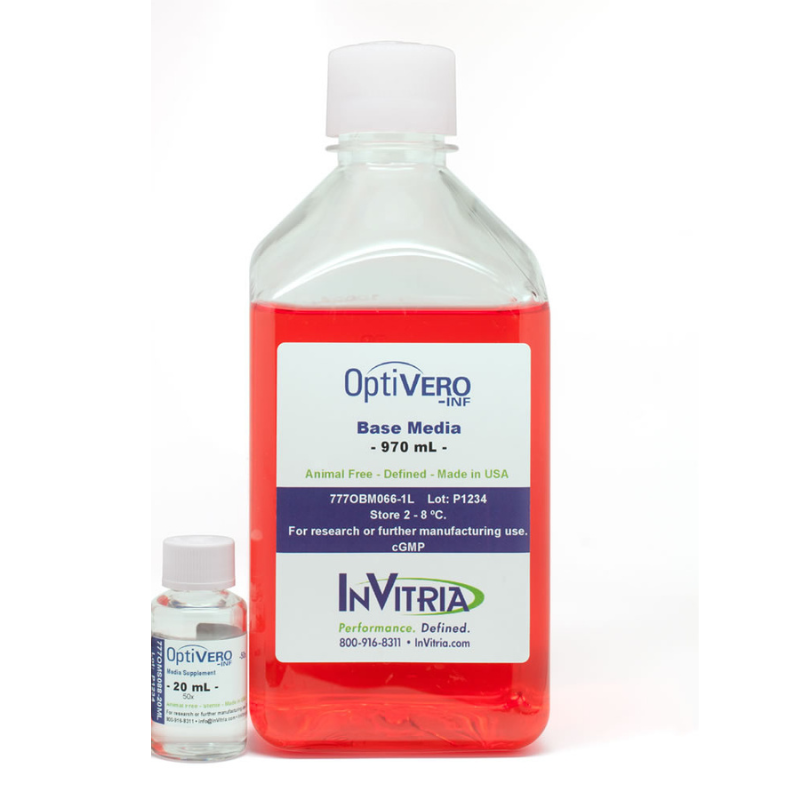
OptiVERO® is a chemically defined, blood-free cell culture media system, specifically formulated to maximize VERO-based virus production in both 2D and 3D culture formats. Unlike traditional media that rely on plant hydrolysates or serum-derived components, OptiVERO provides a fully defined, scalable, and regulatory-friendly solution for vaccine manufacturing, virology research, and viral vector production.
Designed to reduce cell culture variability and accelerate virus manufacturing timelines, OptiVERO is supplied as a two-component kit consisting of a concentrated frozen protein supplement and a base media, allowing for greater flexibility and precise control over media composition.
OptiVERO has been independently validated in multiple peer-reviewed studies, including SARS-CoV-2 vaccine production research published in Vaccines (2023) and viral media optimization studies in Preparative Biochemistry & Biotechnology (2024), demonstrating its performance across diverse virus production applications.
Manufactured in an ISO 9001:2015-certified, cGMP-compliant facility in the United States, OptiVERO ensures batch-to-batch consistency, pathogen-free safety, and global regulatory compliance, making it an ideal solution for virology research and commercial vaccine production.
Ready to try OptiVERO Complete Media?
Advantages
Chemically Defined VERO-Optimized Performance
- OptiVERO was formulated specifically for VERO cell biology through a Design of Experiments (DOE)-based optimization across 37 media components, with VERO cell proliferation as the primary readout (Alfano et al., 2020).
- VERO cell growth kinetics in OptiVERO are equivalent to EMEM-10% FBS and faster than plant-hydrolysate-based serum-free media across both 2D and 3D culture formats.
- In 3D dynamic microcarrier culture, VERO cells in OptiVERO reached 1.7 × 10⁶ cells/mL at day 5 versus 8.8 × 10⁵ cells/mL in FBS-containing media and 1.1 × 10⁶ cells/mL in plant-hydrolysate-based media.
Blood-Free, Chemically Defined Formulation
- Contains no fetal bovine serum, no plant hydrolysates, and no other undefined components that introduce lot-to-lot variability into VERO-based manufacturing processes.
- All supplementing proteins are recombinant human sequence produced in a non-animal, non-human, non-yeast expression system, eliminating adventitious agent qualification burden associated with serum-derived raw materials.
- Compatible with regulatory guidance from FDA, EMA, and PMDA encouraging the elimination of animal-derived components from vaccine manufacturing processes.
Two-Component Kit Architecture
- Supplied as a 980 mL chemically defined base medium plus a 20 mL 50× concentrated protein supplement, allowing users to prepare only the volume needed and store the supplement separately.
- Enables process development flexibility during formulation optimization, feed-strategy development, and scale-up evaluation.
- Compatible with closed-system bioreactor integration for commercial-scale vaccine and viral vector workflows.
Regulatory-Ready Documentation
- Manufactured under cGMP-compliant Quality Management System with respect to 21 CFR 210/211 at ISO 9001:2015-certified facility.
- Supported by Certificate of Analysis, Certificate of Origin / Animal-Free Statement, TSE/BSE Statement, cGMP Statement, ISO 9001 certificate, and peer-reviewed performance data published in Biotechnology and Bioengineering.
- Extended Quality and Regulatory documentation package available for IND filings, BLA submissions, and comparability studies.
Applications
Vaccine Manufacturing. VERO cells are the dominant continuous cell line for human vaccine production and have been in commercial use as a vaccine substrate for more than 40 years (Montagnon et al., 1983; Barrett et al., 2009). VERO-based vaccines approved or in development include polio (inactivated polio vaccine, IPOL), rabies, rotavirus (Rotateq), Japanese encephalitis, Ebola (ERVEBO, which uses InVitria's Exbumin as a formulation excipient), smallpox vaccines, and multiple inactivated SARS-CoV-2 vaccine programs. OptiVERO supports VERO expansion and virus production for these workflows with chemically defined raw material composition that simplifies CMC documentation for IND, BLA, and marketing authorization submissions. Regulatory guidance from FDA, EMA, and PMDA has progressively encouraged elimination of animal-derived components (including fetal bovine serum) from vaccine manufacturing processes, and chemically defined media like OptiVERO align with this regulatory trajectory.
Viral Vector Production. While HEK293 cells remain the dominant substrate for AAV and lentivirus production, VERO cells are used for select viral vector programs — particularly in oncolytic virus development (reovirus, vaccinia-based vectors) and in regions where VERO-based infrastructure is already qualified. OptiVERO supports these viral vector workflows with the same chemically defined raw material profile that is increasingly required for cell and gene therapy CMC submissions under CBER and EMA guidance.
Oncolytic Virus Development. Oncolytic viruses — engineered viral therapeutics that selectively replicate in and lyse tumor cells — frequently use VERO cells as the production substrate during preclinical development and early-stage clinical manufacturing. OptiVERO provides a chemically defined, scalable production medium for oncolytic virus programs that require raw material control comparable to biologic drug manufacturing standards.
Process Development and Scale-Up. OptiVERO supports VERO cell culture across small-scale flask formats through microcarrier-based bioreactor configurations, including the iCellis fixed-bed bioreactor platform used for commercial-scale VERO manufacturing. The two-component kit architecture enables process development teams to characterize protein supplement requirements independently from base medium behavior — useful during media optimization, feed strategy development, and scale transfer between development-scale and manufacturing-scale vessels.
2D Monolayer and 3D Microcarrier Culture. OptiVERO has been characterized in both standard 2D flask formats and 3D dynamic microcarrier systems, with peer-reviewed performance data demonstrating superior cell expansion in microcarrier culture compared to FBS-containing and plant-hydrolysate-based serum-free alternatives (Alfano et al., 2020). Applications include traditional monolayer virus infection workflows, suspension-adapted microcarrier virus production, and fixed-bed bioreactor-based commercial manufacturing.
OptiVERO Technical Specifications
Key specifications for OptiVERO as supplied — including purity, endotoxin, formulation, storage, and manufacturing standards. Full Certificate of Analysis available upon request.| Specification | Details |
|---|---|
| Product Name | OptiVERO® Complete Media Kit |
| Brand | InVitria® |
| Catalog Number | 555OCM0039 |
| Product Form | Liquid — two-component complete cell culture medium |
| Class | Chemically defined, animal-origin-free VERO cell culture medium |
| Cell Type | VERO |
| Formulation | Sterile 20% w/v (200 mg/mL) liquid |
| Protein Supplement | Recombinant human serum albumin + recombinant human transferrin |
| Appearance | Base medium: clear pinkish-red liquid; Protein supplement: clear liquid |
| Carrier Protein / Stabilizer | None (no additives or preservatives) |
| Sterility | Sterile (filtered) |
| Packaging | 1 L kit: 980 mL base medium + 20 mL 50× frozen protein supplement |
| Storage Conditions | Base medium: 2–8 °C; Protein supplement: –20 °C |
| Shelf Life | 2 years |
| Animal-Origin-Free | Yes |
| Production Standard | ISO 9001:2015, cGMP-compliant facility |
| Country of Origin | USA (Junction City, KS) |
Why Select OptiVERO Over Traditional VERO Media?
| Key Attribute | OptiVERO Complete Media | Traditional Serum-Based Media | Plant Hydrolysate Media |
|---|---|---|---|
| COMPOSITION & DEFINITION | |||
| Chemically defined | ✅ Yes | ❌ No (serum variability) | ❌ No (hydrolysate complexity) |
| Animal-origin-free | ✅ Yes | ❌ No (FBS required) | ✅ Typically yes |
| Batch-to-batch consistency | ✅ High (recombinant proteins) | ❌ Variable (donor pools) | ❌ Variable (plant source) |
| Known protein composition | ✅ Three defined recombinants | ❌ Undefined serum proteins | ❌ Complex undefined mixtures |
| Recombinant protein components | ✅ | ❌ Animal-derived proteins | ❌ Plant-derived proteins |
| SAFETY PROFILE | |||
| TSE/BSE risk | ✅ None | ❌ Present (serum) | ✅ None |
| Regulatory documentation | ✅ Complete cGMP package | ❌ Limited | Varies by supplier |
| cGMP compliance | ✅ Yes (ISO 9001:2015 facility) | ❌ Not guaranteed | Varies by supplier |
| Adventitious agent risk | ✅ None | ❌ Present (animal-derived) | ✅ Low |
| PERFORMANCE VALIDATION | |||
| Virus yield consistency | ✅ High | ❌ Variable | ❌ Variable |
| Scale-up predictability | ✅ Excellent | ❌ Challenging | ❌ Moderate |
| Multi-format compatibility | ✅ 2D and 3D validated | ❌ Format-dependent | ❌ Format-dependent |
| Lot-to-lot virus titer variance | ✅ Low (<10% CV) | ❌ High (>25% CV) | ❌ Moderate (15-20% CV) |
| LOT-TO-LOT CONSISTENCY | |||
| Consistent lot-to-lot performance | ✅ Yes — controlled recombinant production | ❌ Variable — source-dependent | ❌ Variable — source-dependent |
| Performance traceable to a single manufacturing process | ✅ Yes — ExpressTec platform | ❌ Multi-donor plasma pool | ❌ No (multiple plant sources and processing methods) |
| SUPPLY CHAIN AND SCALABILITY | |||
| Scalable production (metric-ton capacity) | ✅ Yes | ❌ Limited by plasma donor supply | ✅ Yes (plant-based raw materials are abundant) |
| Supply independent of blood donation | ✅ Yes | ❌ Dependent on donor supply | ✅ Yes (plant-derived materials) |
| Scale-up partnership with customer programs | ✅ Yes — InVitria scales with customer programs from clinical through commercial | ❌ Typically not provided | ❌ Variable by supplier (most focus on commodity supply vs partnership) |
| Manufactured in United States | ✅ Yes — Junction City, Kansas | Varies by supplier | Varies by supplier |
| Supports animal-free and sustainable sourcing mandates | ✅ Yes | ❌ No | ✅ Yes (plant-based materials meet AOF requirements) |
| REGULATORY AND DOCUMENTATION SUPPORT | |||
| ISO 9001:2015 certified manufacturing | ✅ Yes | Varies by supplier | Varies by supplier |
| cGMP-compliant QMS (21 CFR 210/211) | ✅ Yes | Varies by supplier | Varies by supplier |
| Certificate of Origin | ✅ Available | Varies by supplier | Varies by supplier |
| Animal-Free Statement | ✅ Available | ❌ Not applicable | ✅ Typically available (plant-derived materials) |
| Regulatory support package | ✅ Yes — full dossier-quality documentation for IND and BLA submissions | ❌ Limited or supplier-dependent | ❌ Limited or supplier-dependent |
| Technical support for regulatory filings | ✅ Yes — InVitria technical team supports customer regulatory submissions | ❌ Not typically provided | ❌ Typically not provided (commodity suppliers) |
OptiVERO Frequently Asked Questions (FAQs)
Product Overview
What Is OptiVERO?
OptiVERO is a chemically defined, animal-origin-free, complete cell culture media system specifically formulated for VERO-based virus production. It consists of a base media and concentrated protein supplement containing three proteins. This two-component design provides superior virus yields while eliminating the variability associated with serum-based or plant hydrolysate-based media.
What Makes OptiVERO Different From Other VERO Media?
OptiVERO is the only VERO media that combines complete chemical definition with peer-reviewed validation across multiple virus types. Unlike serum-based media, it eliminates donor variability and TSE/BSE risk. Unlike plant hydrolysate media, it provides fully defined composition with known protein components, enabling predictable scale-up and consistent regulatory documentation.
What Viruses Have Been Successfully Produced Using OptiVERO?
Published research demonstrates successful production of SARS-CoV-2 (in M2VeroA cells for vaccine manufacturing), Yellow Fever virus (in primary chicken embryonic fibroblasts), and influenza M2SR vectors. Additional application notes document performance with Dengue, Zika, and other flaviviruses in both 2D and 3D culture systems.
Technical Performance
What Recombinant Proteins Are Included in OptiVERO?
OptiVERO contains three recombinant proteins in its concentrated supplement. These proteins provide the essential growth factors and protective functions typically derived from serum, but with defined composition and consistent performance.
How Does OptiVERO Compare to Serum-Containing Media for Virus Production?
Published data show OptiVERO delivering equivalent or superior virus yields compared to serum-containing media, with significantly improved batch-to-batch consistency. The chemically defined composition eliminates the donor-to-donor variability that can affect virus titers when using serum-based formulations.
Can OptiVERO Be Used in Both 2D and 3D Culture Systems?
Yes. OptiVERO has been validated in both 2D tissue culture flask applications and 3D microcarrier bioreactor systems. This dual compatibility enables seamless scale-up from laboratory research to commercial manufacturing without media reformulation.
What Viruses Have Been Successfully Produced Using OptiVERO?
Published research demonstrates successful production of SARS-CoV-2 (in M2VeroA cells for vaccine manufacturing), Yellow Fever virus (in primary chicken embryonic fibroblasts), and influenza M2SR vectors. Additional application notes document performance with Dengue, Zika, and other flaviviruses in both 2D and 3D culture systems.
Applications and Use
Can OptiVERO Be Used for Commercial Vaccine Manufacturing?
Yes. OptiVERO is manufactured under cGMP-compliant conditions with full regulatory documentation to support commercial vaccine production. Its animal-origin-free status and chemically defined composition align with current regulatory preferences for vaccine manufacturing media.
Is OptiVERO Suitable for Live-Attenuated Vaccine Production?
Yes. OptiVERO has been validated for live-attenuated vaccine production, including influenza M2SR vectors in published SARS-CoV-2 vaccine research. Its defined composition provides the nutritional support required for live virus production while ensuring consistent vaccine quality.
Can OptiVERO Be Used for Gene Therapy Vector Production?
Yes. While specific gene therapy applications are under development, OptiVERO's chemically defined, animal-origin-free profile makes it well-suited for viral vector production where regulatory compliance and batch consistency are critical requirements.
Regulatory and Quality
Is OptiVERO Manufactured Under GMP Conditions?
Yes. OptiVERO is manufactured at InVitria's ISO 9001:2015-certified, cGMP-compliant facility in Junction City, Kansas, USA, ensuring the quality standards required for vaccine and biopharmaceutical manufacturing.
What Quality Documentation Is Available for OptiVERO?
OptiVERO is supported by Certificate of Analysis, Safety Data Sheet, Guidelines for Use, Certificate of Origin and Animal-Free/TSE-BSE Statement, ISO 9001 certificate, and cGMP Statement. Additional regulatory documentation is available to support IND and BLA filings.
Does OptiVERO Contain Animal-Derived Components?
No. OptiVERO is completely animal-origin-free, containing only recombinant proteins produced using InVitria's animal-free expression systems. This eliminates TSE/BSE risk and supports regulatory compliance for animal-free manufacturing mandates.
Storage and Handling
How Should OptiVERO Be Stored?
Store the base media at room temperature and the protein supplement at -20°C per the Guidelines for Use. Once combined, use the complete media according to standard cell culture practices. Avoid repeated freeze-thaw cycles of the protein supplement.
What Is the Shelf Life of OptiVERO?
Both the base media and protein supplement have a 2-year shelf life when stored under recommended conditions. Once combined, follow standard cell culture media handling practices for optimal performance.
Ordering and Support
How Do I Transition from Serum-Based Media to OptiVERO?
InVitria provides technical support for media transition, including protocols for cell adaptation and process optimization. Most VERO cell lines adapt readily to OptiVERO, typically within 3-5 passages, with maintained or improved virus production characteristics.
How Can I Order OptiVERO?
OptiVERO is available worldwide through multiple purchasing pathways. Most customers work directly with InVitria for full access to the OptiVERO product portfolio, bulk and commercial-scale supply, favorable volume-tier pricing, faster supply chain turnaround, GMP supply commitments, and regulatory documentation support. OptiVERO is also available through Fisher Scientific, VWR, and the Labviva procurement platform (which integrates with Ariba, Coupa, Oracle, and Jaggaer) for customers whose institutional procurement systems require integrated supplier ordering. European customers can order with direct fulfillment from InVitria's Rotterdam, Netherlands facility. All customers receive the same product, Certificate of Analysis, and technical support regardless of channel. Contact InVitria or request bulk pricing to place an order.
Is Technical Support Available for OptiVERO Implementation?
Yes. InVitria's Product Applications Team provides technical support for OptiVERO implementation, including protocol development, process optimization, and troubleshooting to ensure successful adoption in your specific virus production workflow.
Peer-Reviewed Research Citing OptiVERO
OptiVERO has been cited in peer-reviewed publications spanning vaccine development, gene therapy, cell therapy, and clinical diagnostics. Here are the most-cited papers referencing OptiVERO usage, including distribution catalog numbers.| Paper Title | Journal/Publisher | Year |
|---|---|---|
| Formulation and production of a blood-free and chemically defined virus production media for VERO cells | Biotechnology and Bioengineering | 2020 |
| Recent Advances of Chemical Definition of Cell Culture Media and Excipients for Virus and Viral Vector Manufacturing: A Review | Journal of Bioprocessing & Biotechniques | 2021 |
| A review on serum in culture medium to proliferate mammalian cell lines for human rabies vaccine production | International Journal of Applied Science - Research and Review | 2021 |
| Intranasal Single-Replication Influenza Vector Induces Cross-Reactive Serum and Mucosal Antibodies against SARS-CoV-2 Variants | Vaccines | 2023 |
| Enhanced production of yellow fever virus through tailored culture media optimization | Preparative Biochemistry & Biotechnology | 2024 |