


Albumin in Drug Delivery: Cancer’s Unexpected Achilles’ Heel
Published on 9 April 2025
The Hidden Power of Albumin - Outsmarting Cancer's Drug Resistance
Reading time: 4 minutes
Share this article:


Cancer cells have a sneaky habit. Just when it seems chemotherapy is getting the upper hand, they adapt, pumping drugs out faster than they come in. It’s called multidrug resistance (MDR), and it’s a major roadblock in treating cancers like breast, lung, and pancreatic. But what if the solution to outsmarting these stubborn cancer cells was hiding right in our bloodstream all along?
Enter Human Serum Albumin (HSA)
HSA isn’t just another protein—it’s a natural transport superstar, accounting for about 60% of plasma proteins. Beyond shuttling nutrients, albumin’s non-toxic, biodegradable nature positions it perfectly as a medical Trojan horse. Cancer cells depend heavily on nutrients to fuel their rapid growth, and albumin is one of their favorites.
Cancer’s Greatest Weakness—Its Appetite
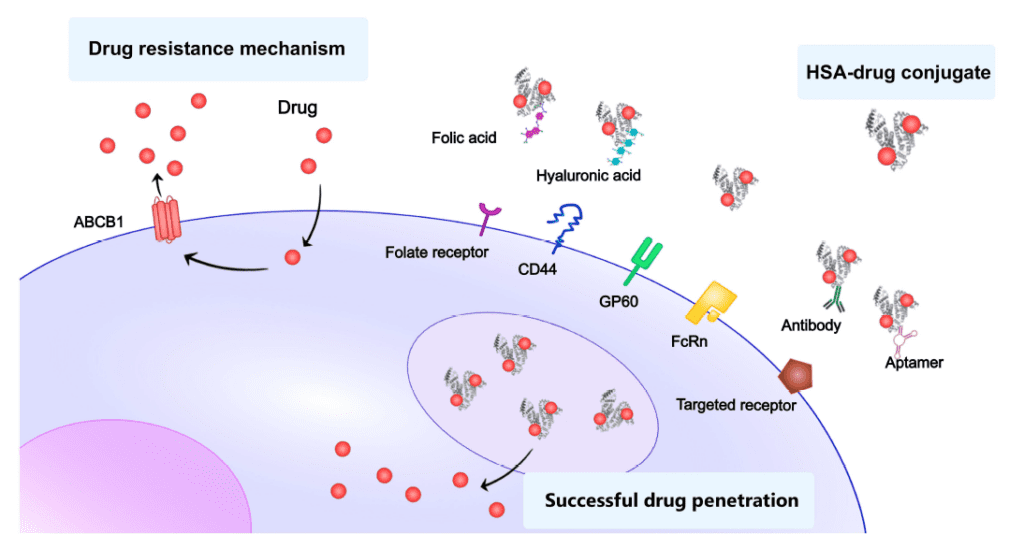
Cancer cells’ insatiable appetite for albumin can be turned against them. In their recent review, researchers at Pomeranian Medical University describe how human serum albumin (HSA) nanoparticles cleverly bypass cancer cells’ defense mechanisms. Instead of being expelled by resistance pumps like MDR1—think of these pumps as stubborn gatekeepers—albumin-bound drugs slip inside unnoticed, appearing more as nutrients than medicine.
How exactly does this happen? Albumin nanoparticles primarily enter cancer cells through receptor-mediated endocytosis, a process where cell-surface receptors such as gp60 and Secreted Protein Acidic and Rich in Cysteine (SPARC) facilitate targeted uptake. By leveraging this natural pathway, albumin nanoparticles effectively circumvent the MDR1 resistance pumps and deliver chemotherapy directly into cancer cells.
Real-World Application: How Albumin is Already Changing Cancer Therapy
- Abraxane: Approved in 2005, Abraxane set the stage by combining paclitaxel with albumin to tackle breast cancer more effectively than traditional formulations. However, patients receiving Abraxane may still experience significant side effects such as neuropathy and myelosuppression, highlighting an ongoing need for further improvement in nanoparticle drug delivery.
- Active Targeting: By attaching targeting molecules like folate or antibodies to albumin nanoparticles, treatments directly pinpoint cancer cells, sparing healthy tissue and reducing side effects.
The Science Behind the Magic
How exactly does albumin accomplish this?
- Passive targeting via the EPR Effect: Tumors naturally accumulate nanoparticles because their vessels are unusually leaky, known as the Enhanced Permeability and Retention (EPR) effect. Albumin-based nanoparticles exploit this property, significantly boosting drug delivery at the tumor site without complicated targeting systems.
- Versatility of Albumin: HSA can bind both hydrophobic and hydrophilic drugs and even imaging agents, providing flexibility to customize treatments.
A Practical Viewpoint: The Need for Recombinant Albumin
While native albumin (from human plasma) has shown tremendous promise, it’s not without its limitations, including supply constraints and safety concerns. Here’s the deal: Recombinant human albumin, like InVitria’s portfolio, offers a scalable, safer alternative. It eliminates concerns around blood-derived contamination and ensures consistency in large-scale pharmaceutical applications.

Why Does This Matter?
Consider this—low albumin levels (hypoalbuminemia) are common in cancer patients, often due to nutritional deficiencies or tumor progression, and have been directly linked to increased chemotherapy-induced toxicity (chemotoxicity) and poorer treatment outcomes (Arrieta et al., 2010). While drug-loaded albumin nanoparticles (e.g., Abraxane) are designed for targeted drug delivery rather than nutritional albumin replenishment, addressing hypoalbuminemia itself through appropriate nutritional interventions or potentially recombinant albumin administration could conceptually help manage chemotoxicity and improve patient tolerance to chemotherapy. However, the direct therapeutic use of recombinant albumin specifically for chemotoxicity remains an area requiring further clinical exploration.
The Bottom Line? Albumin is More Than Just a Carrier—It’s a Game Changer
Cancer treatment desperately needs smarter, safer strategies. HSA-based therapies harness the biology of cancer cells, turning their greatest strength—their voracious appetite—into their biggest vulnerability.
What breakthroughs could recombinant albumin technology unlock next in the fight against cancer drug resistance and toxicity?
So what’s next? The future lies in recombinant albumin technology. If you’re interested in discovering how InVitria’s recombinant albumin products can enhance drug formulation strategies and tackle cancer resistance, let’s connect. Contact us today.
Explore more about recombinant human albumin and join the conversation about transforming cancer therapies through smarter drug delivery solutions.
Read the Paper: Wolf in Sheep’s Clothing: Taming Cancer’s Resistance with Human Serum Albumin?
Stay at the Forefront of Innovation
At InVitria, we’re dedicated to pushing the boundaries of biomanufacturing with advanced, recombinant, and chemically defined solutions. Our team is constantly innovating to support the industry’s evolving needs. Sign up for our newsletter to get early access to product updates, expert insights, and exclusive content.
Featured Solution

Optibumin 25 ® – Recombinant Human Serum Albumin in Bags
Optibumin 25 in bags supports closed-system biomanufacturing with enhanced safety, consistency, and scalability. This high-purity, recombinant, animal-free albumin solution eliminates contamination risks from animal- and human-derived materials, ideal for advanced cell therapy and vaccine workflows. Its chemically defined formulation promotes stable cell growth, viability, and process reliability.
Ready to try Optibumin 25?
Get a free evaluation sample or request a quote for your project.
Frequently Asked Questions
Albumin Biology and Drug Delivery Mechanism
What Is Human Serum Albumin (HSA) and Why Is It Used in Drug Delivery?
Human serum albumin is the most abundant protein in human plasma, accounting for roughly 60% of total plasma protein content. Its natural role is transporting hormones, fatty acids, metals, and a wide range of small molecules through the bloodstream. In drug delivery, this same transport biology makes HSA an ideal carrier — it’s biocompatible, biodegradable, non-immunogenic, and capable of binding both hydrophobic and hydrophilic drug payloads. Albumin-based nanoparticles exploit these properties to improve drug solubility, extend circulation time, and target tumors more effectively than free-drug formulations.
How Do Albumin Nanoparticles Bypass Cancer’s Multidrug Resistance?
Multidrug resistance (MDR) is largely driven by efflux pumps like MDR1 (P-glycoprotein) that actively expel chemotherapy drugs from cancer cells. Albumin nanoparticles sidestep this defense by entering cells through receptor-mediated endocytosis rather than passive diffusion. Surface receptors such as gp60 and SPARC (Secreted Protein Acidic and Rich in Cysteine) recognize albumin as a nutrient source and pull the entire albumin-drug complex inside before MDR1 can recognize and expel the drug payload. The drug effectively enters disguised as food rather than as a threat.
What Is the EPR Effect and Why Does It Matter for Albumin-Based Cancer Therapies?
The Enhanced Permeability and Retention (EPR) effect describes how tumor blood vessels are abnormally leaky and tumor lymphatic drainage is impaired, causing nanoparticles in the 10–200 nm range to accumulate preferentially in tumor tissue rather than healthy tissue. Albumin nanoparticles fall within this size window, which means they passively concentrate at tumor sites without requiring active targeting ligands. This passive targeting effect is layered on top of the active receptor-mediated uptake described above, giving albumin-drug conjugates two independent mechanisms for tumor selectivity.
Approved Therapies and Clinical Context
What Is Abraxane and How Does It Work?
Abraxane (nab-paclitaxel) is an FDA-approved chemotherapy formulation that combines the cancer drug paclitaxel with human serum albumin nanoparticles. Approved in 2005 for metastatic breast cancer and later for non-small-cell lung cancer and pancreatic cancer, it was the first commercially successful demonstration that albumin-bound drug delivery could outperform conventional solvent-based formulations. Abraxane improved tumor drug delivery and eliminated the need for the toxic Cremophor EL solvent used in conventional paclitaxel formulations, though patients can still experience side effects like neuropathy and myelosuppression — which is why next-generation albumin-drug platforms remain an active area of research.
Has Recombinant Human Albumin Been Used in Any FDA-Approved Therapeutics?
Yes. InVitria’s Exbumin recombinant human serum albumin is used as an excipient in Merck’s ERVEBO, the first FDA- and EMA-approved injectable biologic to incorporate recombinant albumin. ERVEBO is an Ebola Zaire vaccine, and its approval established a regulatory precedent for recombinant albumin in injectable formulations — a foundation that future albumin-based therapeutics, including next-generation drug delivery platforms, can build on.
How Does Hypoalbuminemia Affect Chemotherapy Outcomes?
Hypoalbuminemia — abnormally low blood albumin levels — is common in cancer patients due to malnutrition, chronic inflammation, and tumor-driven metabolic changes. Studies including Arrieta et al. (2010) have shown that pre-treatment hypoalbuminemia predicts more severe chemotherapy-induced toxicity in patients with metastatic gastric and colorectal cancers, including higher rates of mucositis, diarrhea, and dose-limiting adverse events. The mechanism is partly pharmacokinetic: many chemotherapy drugs bind albumin in circulation, so when albumin is low, more free drug reaches healthy tissue. This is a separate question from drug-loaded albumin nanoparticles like Abraxane, but it underscores why albumin biology matters across the entire oncology treatment journey.
Recombinant vs. Plasma-Derived Albumin
What Is the Difference Between Recombinant and Plasma-Derived Human Serum Albumin?
Plasma-derived HSA is purified from pooled human blood donations, which carries inherent supply variability, lot-to-lot inconsistency, and theoretical risk of bloodborne pathogen contamination — even with rigorous viral inactivation protocols. Recombinant human serum albumin is produced from a defined expression system without any human or animal-derived inputs, eliminating bloodborne contamination risk and delivering consistent batch-to-batch quality at manufacturing scale. For pharmaceutical applications — particularly excipients in injectable biologics and carriers in nanoparticle drug delivery — recombinant albumin provides the regulatory clarity and supply chain reliability that plasma-derived material cannot match.
What Advantages Does Recombinant Albumin Offer for Next-Generation Drug Delivery Formulations?
For drug developers building albumin-based nanoparticle platforms, recombinant albumin offers four critical advantages over plasma-derived material: (1) defined, animal-free, and human-blood-free composition that simplifies the regulatory pathway for injectable products; (2) consistent purity and structural homogeneity that translates to reproducible nanoparticle assembly and drug-loading; (3) elimination of bloodborne pathogen risk, which is increasingly important as regulatory expectations tighten; and (4) scalable supply that doesn’t depend on plasma donation volumes. InVitria’s recombinant albumin portfolio — including Optibumin 25 in closed-system bags and Exbumin for excipient applications — is designed specifically to support these formulation requirements.
Footnotes
References
- Stukan, I., Grześ, M., Borysławski, K., Kaczorowska, A., Tarnowski, M., & Bajdak-Rusinek, K. (2024). Wolf in sheep’s clothing: Taming cancer’s resistance with human serum albumin. Pharmaceutics, 16(3), 333. https://doi.org/10.2147/IJN.S500997
- Arrieta, O., Michel Ortega, R., Villanueva-Rodríguez, G., Serna-Thomé, M. G., Flores-Estrada, D., & Diaz-Romero, C., et al. (2010). Hypoalbuminemia during chemotherapy predicts severe chemotherapy-induced toxicity in patients with metastatic gastric and colorectal cancers. Medical Oncology, 27(3), 825-830. https://doi.org/10.1007/s12032-009-9292-9