


How Merck Used Recombinant Albumin in ERVEBO to Establish a Novel Excipient Pathway
Published on 15 April 2026
Case Study
Merck’s ERVEBO program became the first known case in which rice-derived recombinant human serum albumin (rd-rHSA) was approved as a novel excipient in a human injectable vaccine. The challenge was not whether albumin itself was known, but whether this specific recombinant material, used at this route, concentration, and formulation context, had been previously “sponsored” and qualified for human injectable use.
BACKGROUND
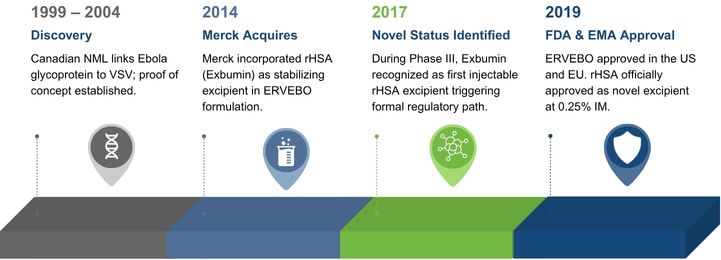
ERVEBO is a live recombinant Ebola vaccine that advanced through a multi-party development pathway before Merck acquired the program in 2014. Earlier vaccine development had already incorporated recombinant human serum albumin as the stabilizing component of the excipient system.
By the time the program entered late-stage development, recombinant human serum albumin was already recognized in pharmaceutical development more broadly, but its use in this specific ERVEBO formulation raised a more complicated question: was this ingredient actually novel from a regulatory standpoint?
THE CHALLENGE
Internally, the debate centered on whether the albumin used in ERVEBO should be treated as a familiar excipient or a novel one.
Several facts complicated the answer:
- The FDA inactive ingredient database identified albumin, but did not distinguish derivation clearly enough to resolve the question.
- Merck had prior experience with recombinant albumin in M-M-R® II, but in that case the reformulation did not result in recombinant albumin being “sponsored” as a final-formulation excipient.
- The ERVEBO program used rice-derived recombinant human serum albumin, while prior recombinant albumin precedent at Merck was tied to yeast-derived material.
- The ERVEBO use case involved intramuscular injection at 0.25%, which raised new questions around route, exposure, and prior qualification.
What Merck Learned About Excipient Approval
A compendial monograph does not equal excipient approval.
Compendial standards help define raw material identity and characterization, but they do not replace use-specific qualification, safety justification, or functional justification within a drug product. In the ERVEBO® case, Merck concluded that prior familiarity with albumin was not enough to resolve whether this specific rice-derived recombinant material had already been qualified for injectable use.
A raw material is not an excipient until a sponsor submits its characteristics, function, and controls for a specific medicinal use. -Source: Kara Stockett Quinn, Novel or Not? Our Inadvertent Journey Filing a Novel Excipient (Merck presentation, July 2020).
Regulatory Consultation and Determination
Merck approached regulators after beginning the internal work needed to support an equivalence argument and excipient qualification strategy. The conversations with FDA and EMA were not identical. FDA emphasized toxicology and nonclinical safety expectations, while EMA required full manufacturing, characterization, and controls detail in a format more closely aligned to a drug substance dossier.
Ultimately, health authorities determined that the use of rice-derived recombinant human serum albumin as a stabilizing component in ERVEBO®, administered by intramuscular injection at 0.25%, was indeed a novel excipient.
- EMA was approached first because of CMC submission timing
- The data package evolved to resemble the excipient section of the final dossier
- Feedback from health authorities was described as clear, collaborative, and transparent
What the Retrospective Review Required
Once novel excipient status became clear, the work expanded significantly.
According to the Quinn presentation, the retrospective review had two main parts:
1. Toxicological assessment
A summary of all relevant nonclinical and clinical data generated on the Ebola vaccine to date, aligned with the FDA’s emphasis on safety justification.
2. Detailed manufacturing, characterization, and controls package
A deeper excipient dossier aligned with EMA expectations, including raw material characterization, process controls, impurities, analytical methods, stability, agricultural controls, and protein acceptance criteria.
This was not a light-touch exercise. It required deeper disclosure, tighter control, and much more detailed excipient understanding than would normally be expected for a routine raw material.
THE OUTCOME
The collaboration between Merck, InVitria, and regulators led to more than just a successful filing. It drove concrete remediation and improvement.
The Quinn deck credits the process with contributing to:
- greater in-process characterization and controls
- increased rHSA powder characterization
- additional acceptance criteria
- further analytical method development, validation, and transfer
- stronger cGMP expectations where appropriate
- tighter change notification standards for both planned and unplanned process changes
Merck’s conclusion was that a custom excipient-grade product was ultimately established to support both the immediate and sustained needs of the vaccine program.
WHY THIS MATTERS
This case matters because it shows what happens when a seemingly familiar ingredient is placed into a new regulatory and formulation context.
The key lesson is not just that recombinant albumin worked in ERVEBO. It is that:
- prior familiarity with a material does not automatically qualify a new use
- route, concentration, derivation, and function all matter
- excipient qualification can become a major CMC workstream late in development if it is not addressed early
- supplier transparency and deep characterization matter when regulatory scrutiny increases
For companies developing vaccines, biologics, or advanced therapies, the ERVEBO experience is a practical example of how excipient choice can directly affect formulation strategy, regulatory burden, and approval path.
THE RECOMBINANT PROTEINS BEHIND THE STORY
The ERVEBO program established a regulatory first for recombinant human serum albumin in an injectable vaccine. The product used in that formulation was Exbumin®. Today, InVitria offers both Exbumin in a lyophilized powder format and Optibumin® 25 in a ready-to-use liquid format for biologic and advanced therapy formulations.
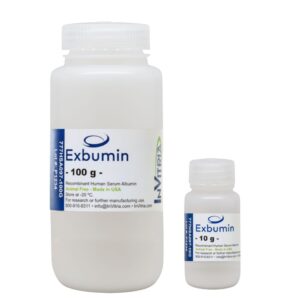
Exbumin – The proven excipient behind the ERVEBO story:
- Used in the ERVEBO vaccine program
- Established injectable excipient precedent
- Supports stability and consistency
- Built for regulatory-ready applications
Best for: programs leveraging established recombinant albumin precedent.
Learn about Exbumin excipient grade recombinant human serum albumin
Optibumin 25 – The next-generation recombinant albumin excipient
- Low aggregates
- High functional Cys34
- Tighter consistency and control
- Supports demanding biologic formulations
Best for: programs prioritizing advanced characterization and formulation control.
Learn about Optibumin 25 excipient grade recombinant humans serum albumin
Built for Qualification
Excipient selection does not end with raw material identity. For regulated biologic and advanced therapy programs, qualification depends on detailed characterization, process understanding, and control strategy.
InVitria supports this process with technical summaries designed to go well beyond a standard data sheet or certificate of analysis. These packages are built to help formulation, quality, and regulatory teams assess excipient suitability with greater confidence.
- Detailed manufacturing and control information
- Expanded analytical characterization
- Tighter acceptance criteria for key quality attributes
- Greater transparency around process consistency and change control
The following content is gated. Please, subscribe to open access to it.
Footnotes
References
Kara Quinn. (2020, July 22). Novel or not? Our inadvertent journey filing a novel excipient [Webinar]. IPEC Americas Excipient Learning Lab / Excipient World Webinar Series. https://education.ipecamericas.org/courses/30181