


rHSA Improves Infectious Lentiviral Titer Yield During Tangential Flow Filtration by Passivating Filter Surfaces
Published on 18 June 2026
Application Note
EXECUTIVE SUMMARY
Infectious lentiviral titer is often lost during tangential flow filtration (TFF) in downstream processing due to shear and viral adsorption to filter membranes. Albumin is a known shear protectant and surface passivator that should address these mechanisms of loss. Bandiera et al. previously demonstrated that coating TFF membranes with plasma-derived human serum albumin is an effective strategy to mitigate titer loss in this unit operation. Here we have evaluated the performance of Optibumin 25, a cGMP, animal-origin-free recombinant, human serum albumin (rHSA), in preserving lentivirus yield during TFF. When membranes were coated with Optibumin, no significant loss of genomic or infectious titer was observed whereas significant losses were sustained when membranes were treated with buffer only. This demonstrates that Optibumin can effectively be used to improve LVV titer without the regulatory burden of blood-derived materials like plasma HSA.
Key Highlights
- Genomic titer maintained with 1% Optibumin during TFF
- Approximately 50% genomic titer loss in HBSS-only TFF
- No significant infectious titer loss with 1% Optibumin treatment
- Nearly 50% infectious titer loss in HBSS-only TFF
- Approximately two-log lower genomic titer in Optibumin permeate
INTRODUCTION
Lentiviral vectors (LVVs) are a critical delivery platform for ex vivo gene modified cell therapies, including chimeric antigen receptor (CAR) T cell products. As these therapies advance toward late-stage clinical development and commercialization, scalable and robust downstream processing strategies are required to ensure consistent vector quality, yield, and manufacturability. Tangential flow filtration (TFF) has become a standard unit operation for lentiviral vector ultrafiltration (UF) concentration and diafiltration (DF) buffer exchange due to its scalability, removal of impurities such as nucleic acids and proteins, and compatibility with current good manufacturing practice (GMP) workflows (Segura et al., 2013; Perry & Rayat, 2021; Moreira et al., 2021). TFF may be performed prior to chromatography to equilibrate the sample as well as after chromatography to formulate the purified virus.
Despite their widespread adoption, tangential flow–based filtration steps are often recognized as a significant source of functional LVV loss. Yields after TFF are variable and can range from 62% to nearly 100% for enveloped viruses (Loewe et al., 2019) but most often range from 70% to 80% in LVV processes (Valkama et al., 2020). Importantly, if TFF is employed both before and after chromatography, these losses correspond to a cumulative yield of 49% to 64% across both TFF steps. Lower recoveries are most frequently observed at larger processing scales where flow rates, shear stress, and residence times increase and when larger pore sizes are chosen, as these are more likely to trap virus particles with the tradeoff of high flux and better impurity removal (Perry & Rayat, 2021; Moreira et al., 2021; Valkama et al., 2020). These losses reflect the intrinsic fragility of lentiviral particles and their sensitivity to hydrodynamic shear, membrane interactions, and prolonged exposure to process surfaces and elevated temperatures, making filtration a recurring downstream bottleneck in LVV manufacturing (Bandeira et al., 2012; Perry & Rayat, 2021). While significant effort has been devoted to optimizing process parameters such as filter pore size, shear rate, and transmembrane pressure, these approaches alone have not eliminated filtration-associated yield losses (Perry & Rayat, 2021; Segura et al., 2013; Segura et al., 2006; Rodrigues et al., 2007).
Several studies have demonstrated that LVV loss during tangential flow operations is largely driven by nonspecific adsorption of viral particles to membranes and other process surfaces (Perry & Rayat, 2021; Valkama et al., 2020; Ruscic et al., 2019; Makino et al.,1994; Bandeira et al., 2012). In particular, Bandeira and colleagues reported only 8.5% yield using Vivaflow® PES membrane cassettes (Sartorious) for TFF, which they were able to rescue by pre-saturating the membranes with human serum albumin (HSA) prior to UF/DF. Non-ionic detergents can also
reduce nonspecific adsorption; however, their retention and clearance during ultrafiltration can be difficult to control, because local detergent concentration at the membrane surface promotes micelle formation (Chu et al., 2025).
In this application note, we build on the conceptual foundation laid by Bandeira and colleagues by evaluating TFF membrane pre-treatment with Optibumin 25, InVitria’s animal-origin-free recombinant human albumin, as a strategy to mitigate LVV losses due to adsorption. Furthermore, we extend this concept by formulating the sample with Optibumin to prevent aggregation prior to filtration as well.
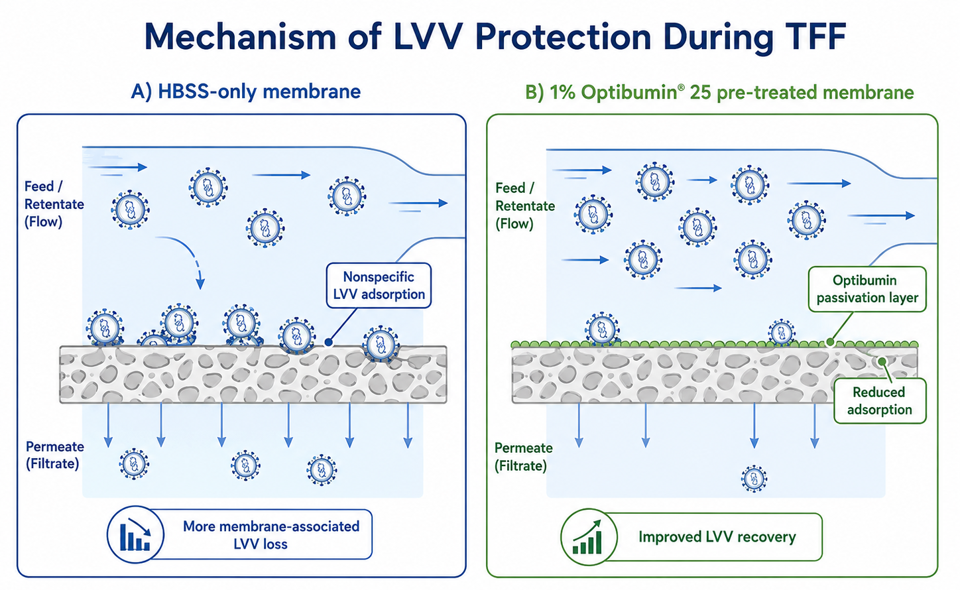
Figure 1. Proposed mechanism of LVV protection during tangential flow filtration (TFF). Pre-treatment with 1% Optibumin 25 passivates TFF membrane surfaces, reducing nonspecific lentiviral vector adsorption and helping preserve viral recovery during concentration.
RESULTS AND DISCUSSION
To assess the effect of Optibumin membrane pre-treatment during TFF, VSV-G pseudotyped LVVs expressing GFP were clarified and processed using a 500 kDa pore size PES 50 cm² TFF cassette. The membrane was pre-coated with either HBSS alone or HBSS containing 1% Optibumin. The concentrated LVV sample was then diluted in the corresponding buffer and concentrated back to the initial volume. Observed titers were lower than expected, likely due to loss during the prior clarification step, which has not yet been fully optimized.
Genomic titer of the pre-filter sample, retentate, and permeate were characterized by RT-qPCR, and titers were adjusted to correspond to the pre-filter sample volume (Figure 2). A significant loss of approximately 50% of the genomic titer was observed in the retentate of the HBSS-only group (Figure 2A) while no loss in genomic titer was observed in the 1% Optibumin rHSA group (Figure 2B).
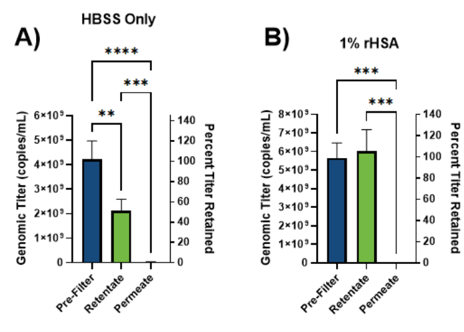
Viral genomic copy number determined by RT-qPCR of pre-TFF samples (blue), post-filter retentate (green), and post-filter permeate (gray) when filters were treated with A) HBSS only or B) HBSS + 1% Optibumin rHSA * p < 0.05, ** p < 0.01, *** p < 0.001, **** p < 0.0001; one-way ANOVA with Tukey post hoc test.
Notably, while the relative amount of titer in the permeate was very small compared to the pre-filter sample and retentate for both groups, the titer in the permeate of the HBSS- only group was approximately two logs higher than that of the 1% Optibumin group. The loss of physical titer in the Optibumin group. The loss of physical titer in the HBSS-only group and the difference in permeate titer between groups support the interperatation that albumin coating reduced viral loss to the filter.
Infectious titer of the pre-filter sample and retentate were characterized by measurement of GFP expression in HT-1080 cells after transduction (Figure 3). Titer measurements were adjusted based on volume to correspond to the initial sample volume. In the HBSS-only group, nearly 50% of the infectious titer was lost during the TFF, which was a significant difference. In contrast, in the 1% Optibumin treatment group, only 30% of the infectious titer was lost during filtration, which was not a significant difference. The permeate was omitted from infectious titer analysis due to the low genomic titer and the high salt concentration in the permeate, which were likely to cause cytotoxicity and interfere with the assay.
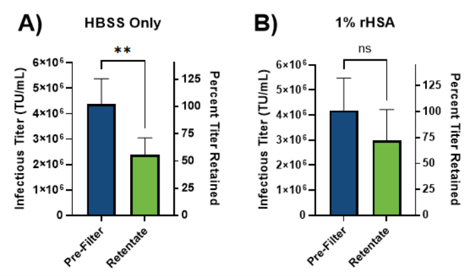
Infectious viral titer determined by HT-1080 cell transduction assay of pre-filter samples (blue) and post-filter retentate (green) when filters were treated with A) HBSS only or B) HBSS + 1% Optibumin rHSA, ns p > 0.05 * p < 0.05, ** p < 0.01, *** p < 0.001, **** p < 0.0001; one-way ANOVA with Tukey post hoc test.
Taken together, the genomic and infectious titer results demonstrate that pre-coating filters with 1% Optibumin 25 prevents the loss of physical virus particles during tangential flow filtration and results in a higher yield of infectious virus across the TFF unit operation in lentivirus processing. Furthermore, because several groups have reported that larger membrane pore sizes can lead to faster processing time and better impurity removal at the expense of greater loss due to adsorption (Perry & Rayat, 2021; Moreira et al., 2021; Valkama et al., 2020), we hypothesize that coating TFF membrane with Optibumin 25 could be an effective strategy to attain these benefits while reducing losses associated with larger pore sizes.
CONCLUSION
To corroborate prior work by Bandiera et al., we evaluated the performance of Optibumin, InVitria’s cGMP, recombinant, animal-free albumin, as a TFF membrane coating. When filters were coated with Optibumin, no significant loss of genomic or infectious titer was observed, whereas when filters were coated with buffer alone, significant amounts of genomic and infectious titer were lost. Taken together, this demonstrates that coating TFF membranes with Optibumin is a straightforward and effective way to preserve lentivirus titer during processing without the
inconsistency, regulatory concerns, or supply chain issues associated with plasma-derived albumin.
MATERIALS AND METHODS
Tangential Flow Filtration
VSV-G pseudotyped LVVs expressing GFP were generated using the Gibco™ LV-MAX™ Lentiviral Production System (Thermo Fisher Scientific) according to the manufacturer’s instructions. Upon harvest, samples were treated with Benzonase® nuclease and clarified by filtration through a 0.45 µm PES filter prior to TFF.
Fifteen mL of clarified LVV sample was diluted 4-fold in LV-MAX cell culture media with or without the addition of Optibumin at a final concentration of 1% (m/v) and a final volume of 60 mL. A 2 mL sample was then collected for analytical testing. A 50 cm², 500 kDa MWCO Pellicon® XL Cassette with Biomax® membrane (PXB500C50, MilliporeSigma) was equilibrated with 50 mL cell culture media with or without the addition of 1% (m/v) Optibumin, for 10 minutes.
The peristaltic pump, a Masterflex® L/S® pump with an Easy-Load® II pump head (Cole-Parmer), was operated at a pump speed of 44 rpm while maintaining a pressure of 5 psi. The feed solution was concentrated from 58 mL to 2 mL while maintaining the same pump speed and pressure. The system was then flushed with 40 mL flush buffer with or without the addition of 1% (m/v) Optibumin. Permeate was collected for genomic titer characterization. Infectious titer was not measured in the permeate due to low genomic titer and high salt concentration, which were likely to cause cytotoxicity and interfere with the assay.
Genomic Titer Quantitation
Lentiviral genomic titer was measured by harvesting viral supernatants. Viral RNA was extracted using the NucleoSpin® RNA Virus Kit (Takara Bio, #740956). Extracted RNA was treated with DNase I to remove any residual plasmid DNA. Purified viral RNA was reverse transcribed and amplified using the Lenti-X® qRT-PCR Titration Kit (Takara Bio, #631236) for quantification using SYBR® Green (Thermo Fisher Scientific) on the QuantStudio™ 3 System (Applied Biosystems, a Thermo Fisher brand). Samples were run in serial dilutions to determine threshold cycle (Ct) values. Ct values were fit to a standard curve of control template RNA with known copy numbers and used to calculate copies per mL. Dilutions outside of the standard curve, or with multiple melt curve peaks, were discarded from analysis.
Infectious Titer Quantitation
HT-1080 cells were seeded at 7,000 cells per well in a 96-well plate in DMEM with 10% FBS and returned to the incubator to allow adhesion. While the cells were adhering, filtered lentivirus samples were serially diluted in DMEM with 10% FBS supplemented with Synperonic® F108 (Croda International). Four hours after plating the cells, the media was exchanged with the diluted virus samples, and the cells were spinoculated at 900 x g for 30 minutes at room temperature before being returned to the incubator. After 16 hours, the media was replaced with fresh DMEM with 10% FBS and the cells were monitored for GFP expression using an Incucyte® SX5 live cell imaging system. At 72 hours post transduction, the percentage of GFP positive cells was recorded. Virus dilutions for which the non-filtered control sample had GFP expression within the linear range of the assay (2.5% to 20% GFP positive) were used to compute the titer using the following equation:
Titer = (F × C / V) × D
Where
F = frequency of GFP+ cells (%GFP+ cells/100)
C = cell number per well at transduction (7,000 cells)
V = volume per well in mL
D = lentivirus dilution factor
Featured Solution
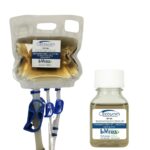
Optibumin 25 – Recombinant Human Serum Albumin, 25% Solution – Animal-Origin-Free, GMP-Produced
Optibumin 25 is a chemically defined, recombinant human serum albumin designed to support viral vector stability and recovery during downstream processing. In this application note, pre-treating TFF membranes with 1% Optibumin helped reduce lentiviral vector loss during tangential flow filtration by passivating membrane surfaces and minimizing nonspecific LVV adsorption.
Unlike plasma-derived HSA, Optibumin is animal-origin-free and avoids the variability, supply concerns, and regulatory burden associated with blood-derived materials. Supplied as a ready-to-use 25% solution, Optibumin integrates easily into TFF workflows as a membrane pre-treatment and formulation component.
Optibumin 25 is well suited for gene therapy and cell therapy manufacturing workflows where infectious titer recovery, process consistency, and chemically defined raw materials are critical.
Ready to try Optibumin 25?
Get a free evaluation sample or request a quote for your project.
Frequently Asked Questions (FAQs)
What does this application note evaluate?
This application note evaluates whether pre-treating tangential flow filtration (TFF) membranes with 1% Optibumin® 25 can reduce lentiviral vector loss during downstream processing. The study compares HBSS-only and Optibumin-treated TFF conditions using VSV-G pseudotyped GFP lentiviral vectors.
Why is lentiviral vector recovery a challenge during TFF?
Lentiviral vectors are fragile enveloped particles that can lose functional titer during downstream processing. During TFF, loss can occur through shear stress, membrane interactions, nonspecific adsorption to filter surfaces, and exposure to process surfaces during concentration.
How does Optibumin® 25 help during TFF?
Optibumin® 25 is used to pre-treat the TFF membrane surface. The recombinant albumin is intended to passivate the membrane surface, helping reduce nonspecific LVV adsorption and supporting better viral recovery during concentration.
What were the main findings?
In the HBSS-only condition, approximately 50% genomic titer loss and nearly 50% infectious titer loss were observed during TFF. In the 1% Optibumin treatment condition, genomic titer was maintained, and infectious titer loss was not statistically significant.
Why does the application note measure both genomic and infectious titer?
Genomic titer measures physical viral genome copies, while infectious titer measures functional virus capable of transducing cells. Measuring both provides a clearer picture of whether TFF affects total viral particle recovery, functional activity, or both.
What does lower genomic titer in the permeate mean?
Lower genomic titer in the permeate suggests less viral material passed through or was lost through the membrane during TFF. In this study, the Optibumin-treated condition showed approximately two-log lower genomic titer in the permeate compared with HBSS-only treatment.
Is Optibumin 25 an animal-origin-free alternative to plasma-derived HSA?
Yes. Optibumin 25 is a recombinant human serum albumin designed to avoid the variability, supply concerns, and regulatory burden associated with blood-derived albumin.
Can this approach be integrated into existing LVV downstream workflows?
Yes. The approach is designed as a membrane pre-treatment step and can be incorporated into TFF workflows without requiring major process changes. Process-specific optimization is still recommended.
Does this application note show complete prevention of LVV loss?
No. The data show reduced LVV loss and improved titer retention with 1% Optibumin treatment. The wording should stay precise: Optibumin reduces loss and helps preserve recovery. It does not completely eliminate all infectious titer loss.
Who is this application note most relevant for?
This application note is relevant for scientists and process development teams working on lentiviral vector manufacturing, gene therapy production, CAR-T workflows, downstream processing, TFF optimization, and chemically defined viral vector workflows.
The following content is gated. Please, subscribe to open access to it.
Footnotes
REFERENCES
- Bandeira, V., Peixoto, C., Rodrigues, A. F., Cruz, P. E., Alves, P. M., Coroadinha, A. S., & Carrondo, M. J. T. (2012). Downstream processing of lentiviral vectors: Releasing bottlenecks. Human Gene Therapy Methods, 23(4), 255–263. https://doi.org/10.1089/hgtb.2012.059
- Chu, L.-K., Du, Z., Billups, M., Oh, H. J., & Zydney, A. L. (2025). Detergent/surfactant retention during ultrafiltration in the formulation of biotherapeutics. Biotechnology Progress, 41(3), e70011. https://doi.org/10.1002/btpr.70011
- Loewe, D., Grein, T. A., Dieken, H., Weidner, T., Salzig, D., & Czermak, P. (2019). Tangential flow filtration for the concentration of oncolytic measles virus: The influence of filter properties and the cell culture medium. Membranes, 9(12), Article 160. https://doi.org/10.3390/membranes9120160
- Makino, M., Ishikawa, G., Yamaguchi, K., Okada, Y., Watanabe, K., Sasaki-Iwaki, Y., Manabe, S., Honda, M., & Komuro, K. (1994). Concentration of live retrovirus with a regenerated cellulose hollow fiber, BMM. Archives of Virology, 139(1–2), 87–96. https://doi.org/10.1007/BF01309456
- Moreira, A. S., Silva, A. C., Alves, P. M., & Carrondo, M. J. T. (2021). Advances in lentivirus purification. Biotechnology Journal, 16(1), Article e2000019. https://doi.org/10.1002/biot.202000019
- Perry, C., & Rayat, A. C. M. E. (2021). Lentiviral vector bioprocessing. Viruses, 13(2), Article 268. https://doi.org/10.3390/v13020268
- Rodrigues, T., Carrondo, M. J. T., Alves, P. M., & Cruz, P. E. (2007). Purification of retroviral vectors for clinical application: Biological implications and technological challenges. Journal of Biotechnology, 127(3), 520–541. https://doi.org/10.1016/j.jbiotec.2006.07.028
- Ruscic, J., Perry, C., Mukhopadhyay, T., Takeuchi, Y., & Bracewell, D. G. (2019). Lentiviral vector purification using nanofiber ion-exchange chromatography. Molecular Therapy: Methods & Clinical Development, 15, 52–62. https://doi.org/10.1016/j.omtm.2019.08.007
- Segura, M. M., Kamen, A., & Garnier, A. (2006). Downstream processing of oncoretroviral and lentiviral gene therapy vectors. Biotechnology Advances, 24(3), 321–337. https://doi.org/10.1016/j.biotechadv.2005.12.001
- Segura, M. M., Mangion, M., Gaillet, B., & Garnier, A. (2013). New developments in lentiviral vector design, production and purification. Expert Opinion on Biological Therapy, 13(7), 987–1011. https://doi.org/10.1517/14712598.2013.779249
- Valkama, A. J., Oruetxebarria, I., Lipponen, E. M., Leinonen, H. M., Käyhty, P., Hynynen, H., Turkki, V., Malinen, J., Miinalainen, T., Heikura, T., Parker, N. R., Ylä-Herttuala, S., & Lesch, H. P. (2020). Development of large-scale downstream processing for lentiviral vectors. Molecular Therapy: Methods & Clinical Development, 17, 717–730. https://doi.org/10.1016/j.omtm.2020.03.025