


The “Cheap” Albumin Paradox: The Actuarial Cost of Serum Albumin in Biomanufacturing
Published on 24 February 2026
Article
Reading time: 7 minutes
Share this article:


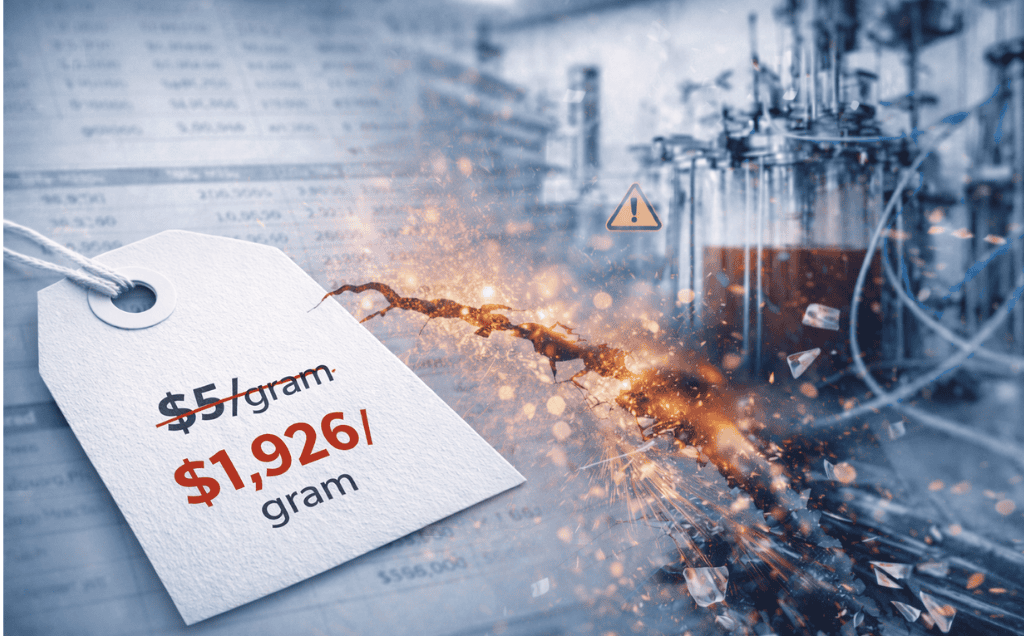
This ledger entry is a financial illusion. It reflects only the acquisition cost and completely ignores the utilization cost created by the inherent stochastic risks of blood-derived materials. When we apply forensic accounting to the risks of viral contamination, lot-to-lot variability, testing burdens, and regulatory friction, the effective price of HSA rises vertically.This article reconstructs the cost of blood-derived HSA by monetizing these risk vectors. By treating contamination events, batch failures, and regulatory delays not as rare anomalies – “unfortunate accidents” – but as actuarial inevitabilities, we demonstrate that for high-value biologics and advanced therapies, the true cost of blood-derived HSA is not $5 per gram, it is often several orders of magnitude higher.
Risk Vector I
Catastrophic Viral Contamination Risk
The most severe liability with serum-derived albumin is its potential to act as a vector for adventitious agents. While viral contamination events are statistically infrequent, their impact on therapeutic manufacturing is catastrophic. These events function as classic “black swans,” low probability, extremely high consequence. The industry reference point remains the Vesivirus 2117 contamination at Genzyme’s Allston Landing facility. In 2009, the facility producing Cerezyme (imiglucerase) and Fabrazyme (agalsidase beta) in Chinese hamster ovary (CHO) cells, suffered a catastrophic complete production shutdown due to Vesivirus 2117 (Smith, 2013). This non-enveloped RNA virus, likely introduced via nutrient additives or serum components, lysed the culture and halted production (Qiu et al., 2013).
The financial impact was devastating. The direct revenue losses, remediation efforts, and regulatory penalties were estimated to be between $100 million and $300 million (Bethencourt, 2009). More significantly, the incident eroded shareholder confidence, contributed to substantial shareholder value destruction, and the strategic vulnerability ultimately cost the company its independence. Before the viral contamination crisis, Genzyme’s stock traded as high as $84 per share. By May 2010, following prolonged manufacturing shutdowns and operational instability, the share price fell to a low of $49.86. With approximately 266 million shares outstanding, this decline represented an estimated total market capitalization loss of $9.08 billion from the company’s peak (“Sanofi-Aventis goes hostile,” 2010).
The Viral Risk Premium Calculation
To estimate the effective cost contribution of this risk, the event must be amortized.
- Probability: Industry consortium data (CAACB) suggests contamination events occur at a rate that supports a conservative annual probability of 0.5% for facilities using animal- or human- derived materials (Barone et al., 2020).
- Impact: A conservative estimate of $500 million is assumed, encompassing direct losses, remediation, and downstream financial impact).
- Consumption: A commercial monoclonal antibody (mAb) facility operating 20 annual 2,000 liter, batches consumes approximately 40,000 grams of albumin.
Step 1: Calculate Annual Expected Risk Cost
Annual risk = Probability × Cost of Event
Annual risk = 0.005 × $500,000,000
Annual risk = $2,500,000
Step 2: Calculate Risk Premium per Gram
Risk premium = Annual risk / Annual Grams Used
Risk premium = $2,500,000 / 40,000 g
Risk premium = $62.50 per gram
The Adjustment:
At the point of use, the effective price jumps from $5.00 per gram to $67.50 per gram. The end-user is implicitly self-insuring against a vesivirus-scale contamination event, absorbing a hidden premium that exceeds the invoice price by 1200%.
Risk Vector II
Variability Risk in Autologous Manufacturing
In the realm of autologous Cell & Gene Therapy (CGT), the definition of a “lot” shifts from a 2,000 liter bioreactor batch, to an individual patient. In this context, the economic consequence of failure is not just inventory loss but clinical failure. Human serum albumin functions as a molecular carrier binding variable quantities of lipids, hormones, and growth factors across donor pools. This compositional variability is a known driver of process deviations in sensitive T-cell expansion workflows (Mishra & Heath, 2021).
The Failure Tax Calculation
In autologous CAR-T manufacturing, the cost of goods sold (COGS) per dose ranges from approximately $58,200 to $95,780 per dose (Harrison et al., 2019). The industry-reported out-of-specification average failure rate hovers between 5% and 10%. If serum-
derived albumin variability contributes conservatively to 2% of failed lots (e.g., failure to meet cell count or potency specs), the resulting cost is astronomical relative to the amount of albumin used.
- Cost of failed lot: $75,000 (average).
- Attributable risk: 2%.
- Albumin load: Approximately 1.25 grams per dose (about 50 mL of 2.5% albumin in final
formulation) (U.S. Food and Drug Administration [FDA], n.d.).
Step 1: Calculate Cost of Failure Attributed to Serum-Derived Albumin
Failure cost = Cost of Lot × Probability of Failure
Failure cost = $75,000 × 0.02
Failure cost = $1,500 per dose
Step 2: Calculate Failure Premium per Gram
Failure premium = Failure Cost / Grams Used per Dose
Failure premium = $1,500 / 1.25 g
Failure premium = $1,200 per gram
The Adjustment:
For cell therapy manufacturers, the “cheap” $5.00 per gram HSA carries an effective surcharge of approximately $1,200 per gram lost manufacturing yield. This estimate excludes reputational damage and the ethical cost associated with patients who are unable to receive therapy due to manufacturing failures.
Risk Vector III
Testing Burden and Time-to-Release Risk
Regulatory guidance, including ICH Q5A and FDA Points to Consider, mandates rigorous adventitious-agent testing when human- or animal-derived raw materials are used (Food and Drug Administration [FDA], 2010). This creates a “Testing Tax” comprised of both direct assay costs and, more crucially, time-related delays.
Common testing requirements include:
- In vivo adventitious agent tests: Inoculation of adult and suckling mice and embryonated eggs. These assays are expensive, typically costing $20,000 – $30,000 per lot and slow, requiring 28 days or more (Sonoma County Department of Health Services, n.d.).
- Specific PCR panels: Screening for human viral pathogens such as HIV, HBV, HCV, Parvovirus B19 (Product Safety Labs, 2020).
By contrast, processes utilizing chemically defined or recombinant materials can often leverage the “3Rs” (Replace, Reduce, Refine) regulatory flexibility, replacing in vivo studies with rapid Next-Generation Sequencing (NGS) or narrower viral panels (International Council for Harmonisation [ICH], 2023).
The Testing Premium Calculation
If switching to a chemically defined, recombinant material eliminates the need for testing on the raw material lot or bulk harvest:
- Testing savings: Approximately $20,000 per lot.
- Albumin usage: 2,000 grams per commercial batch.
Calculation:
Testing premium = Savings / Grams Used
Testing premium = $20,000 / 2,000 g
Testing premium = $10.00 per gram
Although smaller than the viral contamination risk, this $10 per gram premium effectively doubles the invoice price of the HSA itself. For smaller campaigns, this cost amortizes even more poorly, potentially adding hundreds of dollars per gram.
Risk Vector IV
Regulatory Friction and Approval Delays
Human-derived materials introduce additional regulatory scrutiny during biologics license application (BLA) review with a direct cost in valuable time. Chemistry, manufacturing, and controls (CMC) sections containing serum-derived HSA more frequently trigger Information Requests (IRs) related to viral clearance validation, donor screening, and sourcing traceability. Each IR extends review timelines, often by weeks to months, as sponsors must generate additional analyses, documentation, or justification before review can proceed (U.S. Food and Drug Administration, 2018; U.S. Food and Drug Administration, 2020).
Each day of delay in commercial approval has a quantifiable Net Present Value (NPV). For a biologic with peak sales of $1B, a single day of delay costs roughly $2 million in lost revenue (Smith et al., 2024, Tufts CSDD, 2024).
The Regulatory Premium Calculation
If HSA related CMC questions delay approval by a single month (30 days):
- Cost of delay: 30 days × $2M per day = $60M.
- Amortization: Spread over the first 100 kg of commercial production (100,000 g).
Calculation:
Regulatory premium = Cost of Delay / Grams Produced
Regulatory premium = $60,000,000 / 100,000 g
Regulatory premium = $600 per gram
Using a chemically defined excipient simplifies the CMC module, effectively lubricating the approval pathway. The choice to use serum-derived HSA essentially buys a risk of delay valued at $600 per gram.
Risk Vector V
Supply Chain Fragility and Donor Dependence
The risk vectors outlined above focus on the internal quality costs of using serum-derived HSA. However, there are other risk factors related to a very fragile supply chain.
Unlike most GMP raw materials, serum-derived HSA is unique since it cannot be synthesized in a factory. It depends entirely on human plasma collection. This dependency exposes the supply chain to public-health disruptions, border policies, and donor-behavior shifts. The global supply of plasma is heavily concentrated. The United States acts as the “OPEC of Plasma,” responsible for supplying approximately two-thirds of the world’s source plasma (Jaworski, 2023; Shah, 2014). This dominance creates a single point of
failure.
Furthermore, a significant portion of this collection occurs in border regions. Over 50 plasma centers are located along the U.S.-Mexico border, historically relying on Mexican nationals crossing the border to donate. Prior to 2020, industry data suggested that a significant percentage of U.S. collections in these regions were derived from cross-border donors (Ornstein & McGinty, 2022).
The COVID-19 pandemic exposed yet another external risk vector that is arguably the most threatening to the “vein-to-vein” consistency required in cell therapy: Supply chain fragility driven by novel pathogens.
The COVID-19 Stress Test
The COVID-19 pandemic exposed this fragility:
- Drop in collections: In 2020, U.S. plasma collections dropped by approximately 20% compared to 2019 (Hartmann et al., 2020; Plasma Protein Therapeutics Association. 2021). Fear of infection kept donors away from centers, and lockdowns restricted movement.
- Border closures: The closure of the U.S.-Mexico border to non-essential travel, and subsequent policy changes by U.S. Customs and Border Protection (CBP) regarding B1/B2 visa holders, decimated collection volumes in border zones.
- The lag effect: Because plasma fractionation takes 7–12 months, the supply shock of 2020 resulted in shortages of finished HSA in 2021 and 2022.
For autologous therapies, where manufacturing timelines are measured in days and patient lives hang in the balance, a raw material stockout is not merely a delay, it is a treatment failure.
For a CAR-T manufacturer, this disruption presented a catastrophic scenario: a patient’s T-cells have been harvested (apheresis) and are ready for expansion or cryopreservation, but the GMP-grade albumin required for the media or wash buffer is on allocation or
backorder. In this context, supply reliability is not an operational preference; it is a clinical requirement.
Actuarial Probability of Future Pandemics
This was not a one-time event. Actuarial studies on pandemic risk suggest that the frequency of large-scale events is increasing, driven by zoonotic spillover, urbanization, and global connectivity.
- Probability: Modeling published in the Proceedings of the National Academy of Sciences estimates that the annual probability of a pandemic with an impact similar to COVID-19 is approximately 2% to 3.3% (Marani et al., 2021).
- Trend: The likelihood of extreme epidemics events is projected to increase roughly by threefold in the coming decades.
The Supply Resilience Premium Calculation: CAR-T Case Study
To monetize this risk in the context of cell therapy, we calculate the expected financial loss of a facility shutdown caused by a serum-derived albumin stockout.
Note: Unlike bulk biologics, cell therapies consume lower absolute quantities of albumin (~10,000 g annually), but the economic value supported per gram is orders of magnitude higher due to the patient-specific nature of autologous manufacturing.
Scenario: A commercial cell therapy facility producing an approved CAR-T therapy, generating $500 million in annual revenue, relies on just-in-time (JIT) inventory of serum-derived HSA for cell washing and formulation. A novel pathogen outbreak causes a
global plasma supply crunch, forcing a 14-day production halt.
Financial Parameters:
- Albumin use: 10,000 grams of HSA annually
- Daily revenue loss: For a $500 million per year product, the daily revenue is roughly $1.37 million.
- Cost of downtime: Even when idle, an ISO 5/7 cleanroom incurs substantial fixed costs. At a conservative daily burn rate of $250,000 for labor, overhead, and utilities, plus lost revenue, total losses are approximately $1.62 million per day.
- Duration of disruption: 14 days.
- Total event cost: 14 days × $1.62M per day = $22.68 million.
- Annual probability: 2.5% annual probability of a pandemic-level disruption (Marani et al., 2021).
Step 1: Calculate Annual Expected Risk Cost
Annual expected risk = Total event cost x probability annual expected risk = $22,680,000 x 0.025 Annual Expected Risk = $567,000
Step 2: Calculate Supply Resilience Premium per Gram
Supply resilience premium = Annual expected risk / annual grams used supply resilience premium = $567,000 / 10,000 g
Supply Resilience Premium = $56.70 per gram
The Adjustment:
This $56.70/g premium represents the hidden cost of carrying the risk of a global supply chain fracture in a donor-dependent model. It is a “resilience tax.” While recombinant alternatives may carry a higher upfront sticker price, they eliminate this volatility premium entirely by decoupling the supply chain from human biology and geopolitical borders.
The “True Cost” Ledger
The Recombinant Arbitrage
The economic argument for serum-derived human serum albumin (HSA) collapses when procurement accounting is replaced with an actuarial analysis. The nominal price of $5 per gram is not a saving; it is a down payment on a massive, hidden debt structure.
When we sum these premiums, the “True Cost” of using serum-derived albumin in high-value manufacturing creates a staggering liability. However, the most critical insight for decision-makers is not the aggregate total, but the individual weight of the risks.
The hesitation to switch to Recombinant Human Albumin is often driven by its higher raw material price compared to serum-derived HSA. Yet, our analysis reveals a definitive financial tipping point: Every major risk vector, taken in isolation, costs more than the price of the recombinant alternative. You do not need to suffer a “perfect storm” of failures to lose money on blood-derived HSA. You only need to face one:
- The Viral Risk alone ($62.50/g) exceeds the typical procurement cost of recombinant alternatives.
- The Variability Risk alone ($1,200/g) exceeds the cost of recombinant material by over 20x.
- The Regulatory Risk alone ($600/g) exceeds the cost of recombinant material by nearly 10x.
- The Supply Chain Fragility Risk alone ($56.70/g) exceeds the cost of recombinant alternatives.
- The Testing Premium alone ($10.00/g) doubles the invoice price of serum-derived HSA before any other risk is realized.
Serum albumin is not a low-cost material. It is a high-volatility asset that requires continual and expensive hedging in the form of testing, facility insurance, and process over-design. Transitioning to a recombinant, chemically defined albumin is not an incremental expense. It is a risk-mitigation strategy that eliminates actuarial exposure at a fraction of its implied cost. By switching, manufacturers are effectively purchasing an insurance policy against viral shutdown, batch failure, and regulatory delay.
In modern biopharmaceutical manufacturing, the most expensive raw material is not the one with the highest unit price. It is the one that introduces uncertainty.

{
"@context": "https://schema.org",
"@type": "TechArticle",
"headline": "The \"Cheap\" Albumin Paradox: The Actuarial Cost of Serum Albumin in Biomanufacturing",
"description": "This article applies an actuarial framework to quantify the hidden costs of serum-derived human serum albumin in biomanufacturing, including viral contamination risk, variability, testing burden, regulatory delays, and supply chain fragility.",
"inLanguage": "en",
"keywords": "human serum albumin, HSA, serum-derived raw materials, recombinant human serum albumin, rHSA, animal-origin-free, biomanufacturing, cell therapy, CAR-T, viral contamination, adventitious agent testing, PCR panels, next-generation sequencing, regulatory delays, supply chain fragility",
"articleSection": [
"Executive Summary",
"Catastrophic Viral Contamination Risk",
"Variability Risk in Autologous Manufacturing",
"Testing Burden and Time-to-Release Risk",
"Regulatory Friction and Approval Delays",
"Supply Chain Fragility and Donor Dependence",
"Conclusion",
"References"
],
"author": [
{
"@type": "Person",
"name": "Marcus Curl",
"affiliation": {
"@type": "Organization",
"name": "InVitria"
}
}
],
"publisher": {
"@type": "Organization",
"name": "InVitria",
"url": "https://invitria.com/",
"logo": {
"@type": "ImageObject",
"url": "https://invitria.com/path-to-logo.png"
}
},
"datePublished": "Unknown",
"copyrightYear": "2026",
"mainEntityOfPage": "https://invitria.com/resources/the-cheap-albumin-paradox/",
"url": "https://invitria.com/resources/the-cheap-albumin-paradox/",
"contentUrl": "https://invitria.com/resources/the-cheap-albumin-paradox.pdf",
"about": [
{ "@type": "Thing", "name": "Serum-derived human serum albumin" },
{ "@type": "Thing", "name": "Actuarial cost in biomanufacturing" }
],
"mentions": [
{
"@type": "Product",
"name": "recombinant human serum albumin (rHSA)",
"brand": { "@type": "Brand", "name": "InVitria" }
}
]
}
The following content is gated. Please, subscribe to open access to it.
Footnotes
References
- Barone, P. W., Wiebe, M. E., Leung, J. C., Hussein, I. T. M., Keumurian, F. J., Bouressa, J., Anderson, M., & Kuhlman, T. E. (2020). Viral contamination in biologic manufacture and implications for emerging therapies. Nature Biotechnology, 38(5), 563–572. https://doi.org/10.1038/s41587-020-0507-2
- Bethencourt, V. (2009). Virus stalls Genzyme plant. Nature Biotechnology, 27(8), 681. https://doi.org/10.1038/nbt0809-681a
- DiMasi, J. A., Grabowski, H. G., & Hansen, R. W. (2016). Innovation in the pharmaceutical industry: New estimates of R&D costs. Journal of Health Economics, 47, 20–33. https://doi.org/10.1016/j.jhealeco.2016.01.012
- Food and Drug Administration. (2010). Guidance for industry: Characterization and qualification of cell substrates and other biological materials used in the production of viral vaccines for infectious disease indications; availability. Federal Register, 75(42), 9905. https://www.federalregister.gov/documents/2010/03/04/2010-4553/guidance-for-industry-characterization-and-qualification-of-cell-substrates-and-other-biological
- Harrison, R. P., Medcalf, N., Rafiq, Q. A., & Jenkins, D. (2019). The long road to affordability: A cost of goods analysis for an autologous CAR-T process. Cell & Gene Therapy Insights, 5(1), 73–88. https://www.insights.bio/cell-and-gene-therapy-insights/journal/article/256/the-long-road-to-affordability-a-cost-of-goods-analysis-for-an-autologous-cart-process
- International Council for Harmonisation. (2023). ICH Q5A(R2): Viral safety evaluation of biotechnology products derived from cell lines of human or animal origin. U.S. Food and Drug Administration. https://www.fda.gov/media/177719/download
- Jaworski, P. (2023). The case for commercial compensated plasma collections. Niskanen Center. https://www.niskanencenter.org/the-case-for-commercial-compensated-plasma-collections/
- Marani, M., Katul, G. G., Pan, W. K., & Parolari, A. J. (2021). Intensity and frequency of extreme novel epidemics. Proceedings of the National Academy of Sciences of the United States of America, 118(35), e2105482118. https://doi.org/10.1073/pnas.2105482118
- Mishra, V., & Heath, R. J. (2021). Structural and biochemical features of human serum albumin essential for eukaryotic cell culture. International Journal of Molecular Sciences, 22(16), 8411. https://doi.org/10.3390/ijms22168411
- Ornstein, C., & McGinty, T. (2022, March 17). Pharma companies sue for the right to buy blood from Mexicans along the border. ProPublica. https://www.propublica.org/article/pharma-companies-sue-for-the-right-to-buy-blood-from-mexicans-along-border
- Plasma Protein Therapeutics Association. (2021). Plasma donations remain disappointingly low through ongoing pandemic, risking patients’ lives. https://www.pptaglobal.org/material/plasma-donations-remain-disappointingly-low-through-ongoing-pandemic-risking-patients-lives
- Product Safety Labs. (2020). 2020 price schedule: GLP toxicology. https://cdnmedia.productsafetylabs.com/psl/media/1121/price-schedule-2020rev1.pdf
- Qiu, Y., Jones, N., Busch, M., Pan, P., Keegan, J., Zhou, W., Plavsic, M., Hayes, M., McPherson, J. M., Edmunds, T., Zhang, K., & Mattaliano, R. J. (2013). Identification and quantitation of Vesivirus 2117 particles in bioreactor fluids from infected Chinese hamster ovary cell cultures. Biotechnology and Bioengineering, 110(5), 1342–1353. https://doi.org/10.1002/bit.24791
- Sanofi-Aventis goes hostile in battle for Genzyme. (2010, October 4). The Guardian. https://www.theguardian.com/business/2010/oct/04/sanofi-aventis-goes-hostile-genzyme-battle
- Shah, S. (2014, May 8). Blood money: The twisted business of donating plasma. The Atlantic. https://www.theatlantic.com/health/archive/2014/05/blood-money-the-twisted-business-of-donating-plasma/362012/
- Smith, K. (2013). Clearing viral concerns in animal-derived biomaterials. BioPharm International, 26(8). https://www.biopharminternational.com/view/clearing-viral-concerns-animal-derived-biomaterials
- Smith, Z. P., DiMasi, J. A., & Getz, K. A. (2024). New estimates on the cost of a delay day in drug development. Therapeutic Innovation & Regulatory Science. https://pubmed.ncbi.nlm.nih.gov/38773058/
- Sonoma County Department of Health Services. (n.d.). Public health regional laboratory price list for testing services. https://sonomacounty.gov/health-and-human-services/health-services/divisions/public-health/public-health-regional-laboratory/price-list-for-testing-services
- Tufts Center for the Study of Drug Development. (2024). Dollar value of one-day delay in drug development is now 20% of blockbuster era levels (Impact report). Tufts University. https://csdd.tufts.edu/sites/default/files/2025-02/Aug2024%20Day%20of%20Delay%20White%20Paper%20Final.pdf
- U.S. Food and Drug Administration. (n.d.). NDA and BLA approval times. https://www.fda.gov/drugs/nda-and-bla-approvals/nda-and-bla-approval-times
- U.S. Food and Drug Administration. (2017). Best practices for communication between IND sponsors and FDA during drug development. https://www.fda.gov/media/94850/download
- U.S. Food and Drug Administration. (n.d.). YESCARTA (axicabtagene ciloleucel) [Package insert]. https://www.fda.gov/media/108377/download