


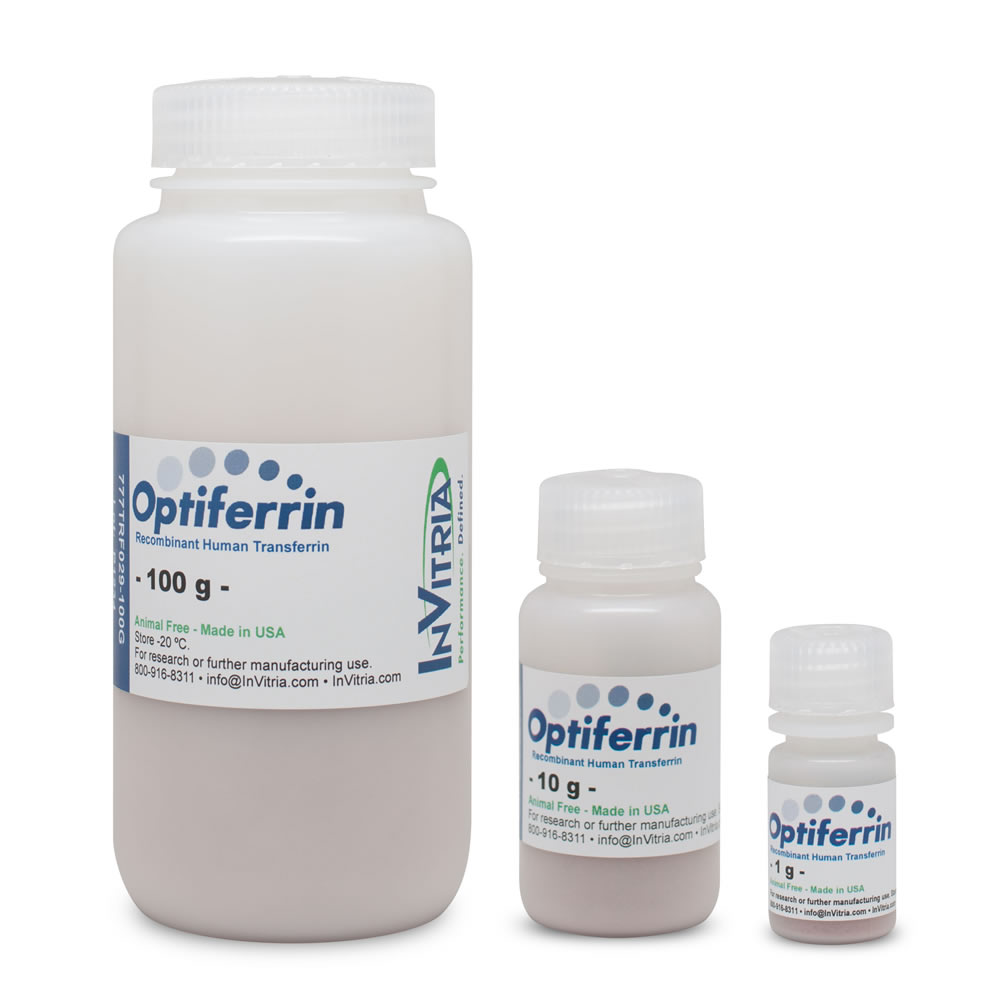
Optiferrin® – Recombinant human transferrin
The most effective way to deliver iron in cell culture without any oxidative reactions or cell damage caused by other iron sources.

Name | Price | Qty | |
|---|---|---|---|
$351.72
|
|||
$2,177.16
|
Product Description
Optiferrin® is InVitria's recombinant human transferrin — a chemically defined, animal-origin-free iron delivery protein for serum-free cell culture media. Every cell in the body requires iron for DNA synthesis, mitochondrial respiration, and enzymatic activity, but free iron catalyzes oxidative reactions that damage cells. Transferrin is the biologically safe mechanism cells evolved to solve this problem: it binds iron tightly in the media, delivers it through receptor-mediated endocytosis on a controlled 15-minute cycle, and prevents the oxidative stress associated with iron salts, iron chelators, and other non-transferrin iron sources (Luck & Mason, 2012; Kawabata, 2022).
Produced using InVitria's ExpressTec expression platform at an ISO 9001:2015-certified, cGMP-compliant facility in Junction City, Kansas, Optiferrin is structurally and functionally equivalent to plasma-derived human transferrin — binding transferrin receptor-1 (TFR1) through the same mechanism, on the same timescale, with the same iron-delivery kinetics (Steere et al., 2012; Zhang et al., 2012). Optiferrin is supplied as a partially iron-saturated recombinant transferrin, which actively scavenges free iron from culture media — converting potentially harmful unbound iron into the safe, receptor-delivered form cells prefer.
Optiferrin is validated across more than ten cell types including hybridomas, T cells, VERO cells, mesenchymal stem cells (MSC), neural stem cells, hematopoietic stem cells (HSC), induced pluripotent stem cells (iPSC), hiPSC-derived cardiomyocytes, fibroblasts, and keratinocytes. It has been cited in peer-reviewed research including publications in Nature Methods, Nature Medicine, Cell Reports, and Molecular Cell — including use at 20 mg/L in hiPSC-derived cardiomyocyte maturation media by the Burridge laboratory at Northwestern University.
Ready to try Optiferrin?
Advantages
Safe, Receptor-Mediated Iron Delivery
- Delivers iron through transferrin receptor-1 (TFR1)-mediated endocytosis — the biologically safe mechanism cells evolved to solve the oxidative damage problem of free iron (Luck & Mason, 2012; Lane et al., 2015)
- Controlled 15-minute endocytic cycle with approximately 90% of transferrin recycled within 30 minutes — supporting sustained, predictable iron delivery across research and high-density biomanufacturing workflows
- Partially iron-saturated formulation actively scavenges free iron from culture media via the high-affinity apo-transferrin binding site (K'₁ = 4.7 × 10²⁰ M⁻¹) — converting potentially harmful unbound iron into receptor-deliverable form
- Minimizes the oxidative stress associated with iron salts, iron chelators, and other non-transferrin iron sources (Kawabata, 2022)
Structurally and Functionally Equivalent to Plasma-Derived Transferrin
- Produced via InVitria's ExpressTec expression platform — a non-mammalian, non-yeast expression host
- Structurally verified to possess the correct sequence and molecular weight of human serum transferrin, and confirmed to compete with plasma-derived transferrin for TFR1 binding sites on CCL-2 and Caco-2 cells (Steere et al., 2012; Zhang et al., 2012)
- Binds Fe³⁺ with nanomolar affinity and the same endocytic kinetics as native human serum transferrin
- Drop-in replacement for plasma-derived human holo transferrin in serum-free and chemically defined cell culture media
Validated in Peer-Reviewed Translational Research
- Cited in peer-reviewed publications including Nature Methods, Nature Medicine, Cell Reports, Molecular Cell, and other peer-reviewed journals
- Used at 20 mg/L in hiPSC-derived cardiomyocyte maturation media by the Burridge laboratory at Northwestern University (Fetterman et al., 2024)
- Validated across more than ten cell types including hybridomas, T cells, VERO cells, MSCs, neural stem cells, HSCs, iPSCs, hiPSC-derived cardiomyocytes, fibroblasts, and keratinocytes
- Enables 71.1% GFP transfection efficiency in serum-free HEK293t workflows (vs. 42.6% under serum conditions) when used at 1 mg/mL — supporting viral vector and recombinant protein production
Animal-Origin-Free Manufacturing and Regulatory-Ready Documentation
- 100% animal-origin-free and blood-free — eliminates adventitious agent risk, donor variability, and regulatory complexity of plasma-derived and mammalian cell–derived transferrin
- Non-mammalian expression system eliminates viral clearance validation requirements associated with mammalian-derived biologics
- Manufactured under cGMP-compliant Quality Management System with respect to 21 CFR Part 210/211 at InVitria's ISO 9001:2015-certified facility in Junction City, Kansas
- Full regulatory documentation package — CoA, SDS, Certificate of Origin and Animal-Free / TSE-BSE Statement, ISO 9001 certificate, cGMP Statement, and Regulatory Support Files for IND filings
Applications
Stem Cell Expansion and Pluripotent Stem Cell Culture Optiferrin delivers the controlled, receptor-mediated iron supply required for long-term expansion and differentiation of induced pluripotent stem cells (iPSC), mesenchymal stem cells (MSC), hematopoietic stem cells (HSC), and neural stem cells in chemically defined, serum-free media. Stem cell workflows are particularly sensitive to iron delivery consistency — variable iron availability disrupts mitochondrial function, proliferation, and differentiation fidelity. Optiferrin's recombinant lot-to-lot consistency and physiological iron delivery mechanism support reproducible stem cell expansion across research, process development, and GMP manufacturing contexts.
hiPSC-Derived Cardiomyocyte Maturation and Translational Research Optiferrin is used in human induced pluripotent stem cell–derived cardiomyocyte (hiPSC-CM) maturation protocols, including published work from the Burridge laboratory at Northwestern University demonstrating compartmentalized functional, metabolic, and transcriptional maturation of hiPSC-CMs in chemically defined media. Typical working concentrations in hiPSC-CM maturation media range up to 20 mg/L. Optiferrin's physiological iron delivery mechanism supports the metabolic demands of cardiomyocyte maturation without introducing the donor variability or adventitious agent risk of plasma-derived transferrin.
Viral Vector and Transfection Workflows Optiferrin supports transient transfection and viral vector production in serum-free workflows for AAV, lentiviral vector, and recombinant protein manufacturing. Published data demonstrate that supplementing serum-free OptiPEAK™ HEK293t media with Optiferrin at 1 mg/mL increases transient transfection efficiency from 42.6% (serum-containing conditions) to 71.1% GFP-positive cells, and improves functional lentivirus titer — supporting viral vector manufacturing for CAR-T, gene therapy, and cell therapy programs (see transient transfection application note).
T Cell, NK Cell, and Immune Cell Expansion Optiferrin supports the iron delivery requirements of T cell, NK cell, regulatory T cell (Treg), and tumor-infiltrating lymphocyte (TIL) expansion workflows in serum-free and chemically defined media. Immune cell expansion is particularly sensitive to iron supply because activated T cells upregulate TFR1 expression and rapidly increase iron uptake during proliferation — Optiferrin's receptor-mediated delivery matches this physiological demand while eliminating the donor variability, adventitious agent risk, and animal-derived components of plasma-derived transferrin.
Production Cell Line and Bioproduction Workflows Optiferrin supports CHO, HEK293, VERO, and hybridoma production cell lines for biologic, vaccine, and recombinant protein manufacturing. It enables adaptation to serum-free and chemically defined media while maintaining the iron supply required for sustained cell productivity in high-density bioreactor cultures. Optiferrin has been validated in hybridoma cell proliferation at concentrations of 0.1–10 mg/L, with performance equivalent to plasma-derived transferrin (see Optiferrin application note).
Vaccine Production and Virus Propagation Optiferrin supports VERO cell–based vaccine manufacturing and virus propagation workflows, providing a chemically defined, animal-origin-free alternative to plasma-derived and bovine transferrin in vaccine production cell culture. Its non-mammalian expression system eliminates the viral clearance validation requirements associated with mammalian-cell–derived raw materials, simplifying regulatory filings for vaccine programs.
Serum-Free Media Formulation Optiferrin serves as the transferrin component in chemically defined, serum-free cell culture media formulations across research, process development, and biomanufacturing applications. Its recombinant consistency and receptor-mediated iron delivery support the development of reproducible serum-free formulations for diverse cell types and applications.
Why Select Optiferrin Over Plasma-Derived Human/Bovine Transferrinn, and Iron Salts/Chealators?
| Key Attribute | Optiferrin (rhTf) | Plasma or Bovine Transferrin | Iron Salts / Chelators |
|---|---|---|---|
| IRON DELIVERY MECHANISM | |||
| Receptor-mediated iron delivery (via TFR1) | ✅ Yes — human sequence, native TFR1 binding | ⚠️ Yes for plasma Tf; species mismatch for bovine Tf | ❌ No — uncontrolled free Fe3+ delivery |
| Non-toxic iron binding and release | ✅ Yes — physiological iron delivery | ✅ Yes (plasma Tf) / ⚠️ Variable (bovine Tf) | ❌ Generates ROS; risks cytotoxicity |
| Iron saturation specification | ✅ Defined | ⚠️ Variable by source | — Not applicable |
| Human-sequence identity | ✅ Yes | ✅ (plasma Tf) / ❌ (bovine Tf) | — Not applicable |
| Supports serum-free, chemically defined media | ✅ Yes | ⚠️ Partial — introduces blood-derived material | ⚠️ Partial — risks cytotoxicity |
| SAFETY PROFILE | |||
| Recombinant production | ✅ Yes | ❌ No (plasma- or animal-derived) | — Not applicable (chemical) |
| Animal-origin-free | ✅ Yes | ❌ Blood- or animal-derived | ✅ Yes |
| Blood-free | ✅ Yes | ❌ Blood-derived (plasma Tf) | ✅ Yes |
| Free of adventitious agent risk | ✅ Yes | ❌ Adventitious agent risk present | ✅ Yes |
| No donor or herd variability | ✅ Yes | ❌ Donor or herd variability | ✅ Yes |
| TSE/BSE risk | ✅ None (no animal source) | ❌ Present (bovine Tf) / ⚠️ donor-dependent (plasma Tf) | ✅ None |
| LOT-TO-LOT CONSISTENCY | |||
| Consistent lot-to-lot performance | ✅ Yes — controlled recombinant production | ❌ Variable — source-dependent | ⚠️ Chemical purity consistent but functional delivery differs |
| Performance traceable to a single manufacturing process | ✅ Yes — ExpressTec platform | ❌ Multi-source or multi-donor | — Not applicable |
| SUPPLY CHAIN AND SCALABILITY | |||
| Scalable production (metric-ton capacity) | ✅ Yes | ❌ Limited by plasma or animal supply | ✅ Yes (chemical manufacturing) |
| Supply independent of blood or animal sourcing | ✅ Yes | ❌ Dependent on donor or animal supply | ✅ Yes |
| Scale-up partnership with customer programs | ✅ Yes — InVitria scales with customer programs from clinical through commercial | ❌ Typically not provided | — Not applicable |
| Vertically integrated supply chain | ✅ Yes — InVitria owns the complete supply chain | ❌ Multiple intermediaries | Varies |
| Manufactured in United States | ✅ Yes — Junction City, Kansas | Varies by supplier | Varies by supplier |
| Supports animal-free and sustainable sourcing mandates | ✅ Yes | ❌ No (plasma Tf) / ❌ No (bovine Tf) | ✅ Yes |
| REGULATORY AND DOCUMENTATION SUPPORT | |||
| ISO 9001:2015 certified manufacturing | ✅ Yes | Varies by supplier | Varies by supplier |
| cGMP-compliant QMS (21 CFR 210/211) | ✅ Yes | Varies by supplier | Varies by supplier |
| Certificate of Origin | ✅ Available | Varies by supplier | Varies by supplier |
| Animal-Free Statement | ✅ Available | ❌ Not applicable | ✅ Available |
| Regulatory support package | ✅ Yes — full dossier-quality documentation for IND and BLA submissions | ❌ Limited or supplier-dependent | ❌ Not typically applicable |
| Technical support for regulatory filings | ✅ Yes — InVitria technical team supports customer regulatory submissions | ❌ Not typically provided | ❌ Not typically provided |
Optiferrin Frequently Asked Questions (FAQs)
Product Overview
What Is Optiferrin?
Optiferrin® is InVitria's recombinant human transferrin — a chemically defined, animal-origin-free iron delivery protein for serum-free cell culture media. Produced using InVitria's ExpressTec expression platform at an ISO 9001:2015-certified, cGMP-compliant facility in Junction City, Kansas, Optiferrin delivers iron through transferrin receptor-1 (TFR1)-mediated endocytosis — the biologically safe mechanism cells evolved to solve the oxidative damage problem of free iron in culture media.
What Is Transferrin and Why Is It Used in Cell Culture?
Transferrin is an iron-binding glycoprotein that delivers iron to cells via the transferrin receptor (TFR1). In cell culture, transferrin replaces the iron-carrier function of serum, supporting proliferation and productivity in serum-free and chemically defined media. Cells require iron for DNA synthesis, mitochondrial respiration, and enzymatic activity, but free iron catalyzes oxidative reactions that damage cells. Transferrin safely sequesters iron and delivers it into cells through receptor-mediated endocytosis, making it the biologically preferred iron source in serum-free bioprocessing (Luck & Mason, 2012; Kawabata, 2022).
What Is Optiferrin Made From?
Optiferrin is produced recombinantly using InVitria's ExpressTec expression platform, a non-mammalian, non-human expression host with no animal-derived, human-derived, or blood-derived materials. Manufacturing is fully animal-origin-free, from raw materials through production equipment to product-contact packaging. The expression system produces a protein structurally and functionally equivalent to human plasma transferrin, but without the pathogen risk, lot variability, or supply constraints associated with plasma-derived or mammalian cell–derived transferrin. This non-mammalian origin also eliminates the viral clearance validation burden that accompanies mammalian-derived biologics in regulated manufacturing.
Why Can't I Just Use Iron Salts or Iron Chelators Instead of Transferrin?
Cells require iron for DNA synthesis, mitochondrial respiration, and enzymatic activity, but free iron (Fe²⁺ and Fe³⁺) catalyzes Fenton chemistry, generating reactive oxygen species that damage DNA, proteins, and lipid membranes (Kawabata, 2022). Iron salts like iron chloride, ferric ammonium citrate, and iron sulfate deliver iron to the media but don't control how or where it enters cells, exposing cultures to oxidative stress. Iron chelators face similar limitations — they bind iron but don't replicate the controlled, receptor-mediated delivery pathway cells evolved to use. Transferrin-mediated delivery through TFR1-dependent endocytosis is the physiologically correct iron-delivery mechanism — sequestering iron safely in the media and releasing it intracellularly through a controlled endocytic cycle (Luck & Mason, 2012; Lane et al., 2015).
Quality and Regulatory
Is Optiferrin cGMP-Manufactured and Animal-Origin-Free?
Yes. InVitria manufactures Optiferrin under a cGMP-compliant Quality Management System (QMS) with respect to 21 CFR Part 210/211 at its ISO 9001:2015-certified facility in Junction City, Kansas, USA. Optiferrin is 100% animal-origin-free — raw materials, production host, manufacturing equipment, and product-contact packaging are all free of animal-derived components. This combination — cGMP manufacture, animal-origin-free certification, and ISO 9001 quality system — supports use in regulated bioprocessing, IND filings, and clinical and commercial manufacturing workflows.
What Are the Purity and Endotoxin Specifications for Optiferrin?
Optiferrin release specifications include: Total Protein >90%, Purity ≥95%, Endotoxin ≤1.0 EU/mg, pH 6.0–8.0, Solubility and Moisture within validated ranges. The product is supplied as a lyophilized powder of recombinant DNA origin.
What Quality Documentation Is Available for Optiferrin?
Optiferrin is supported by a Certificate of Analysis, Safety Data Sheet, Guidelines for Use, Certificate of Origin and Animal-Free / TSE-BSE Statement, ISO 9001 certificate, and cGMP Statement. Additional Quality and Regulatory documentation is available on request — including Regulatory Support Files for IND filings and materials for supplier qualification in cell therapy, gene therapy, and biologics production.
Does InVitria Provide a Drug Master File (DMF) or Equivalent Regulatory Documentation for Optiferrin?
InVitria provides a product-specific Technical Summary for Optiferrin containing CMC-style documentation — including manufacturing process, raw material controls, characterization data, release specifications, and lot analysis — designed to support customer regulatory submissions globally, including IND, BLA, and comparable filings under FDA, EMA, and other regulatory authorities. Unlike a Drug Master File, the Technical Summary is provided directly to the customer for incorporation into their own regulatory documentation, giving customers full visibility into the CMC information and supporting global filings without being tied to a single regulatory pathway. The Optiferrin Technical Summary is supported by per-lot Certificates of Analysis, Animal-Origin-Free / TSE-BSE statements, ISO 9001 certification, cGMP statements, and change notification under defined policies. Contact us to request the Technical Summary.
Why Does the Expression System Matter for Recombinant Transferrin?
Optiferrin is produced in a non-mammalian host, which eliminates the risk of human and mammalian pathogen contamination inherent to CHO or human cell-derived proteins. This non-mammalian origin also removes the viral clearance validation steps typically required for mammalian-derived biologics. For process developers, this means simpler regulatory filings, lower viral safety risk, and fewer downstream purification burdens compared to transferrin produced in mammalian cell lines or yeast expression systems (which can introduce immunogenic yeast host cell proteins requiring extensive purification).
Mechanism and Performance
How Does Optiferrin Deliver Iron to Cells?
Optiferrin delivers iron through receptor-mediated endocytosis via transferrin receptor-1 (TFR1) — the same mechanism used by plasma-derived transferrin. At physiological pH, iron-bound transferrin binds TFR1 on the cell surface and is internalized via clathrin-dependent endocytosis. Subsequent acidification of the endosome triggers release of iron from transferrin, where Fe³⁺ is reduced to Fe²⁺ before export to the cytosol. The iron-free transferrin/TFR1 complex returns to the cell surface, and apo transferrin dissociates to bind additional Fe³⁺ and repeat the cycle. Each full cycle is completed in roughly 15–16 minutes, with approximately 90% of transferrin recycled within 30 minutes (Luck & Mason, 2012).
How Does Optiferrin Compare to Plasma-Derived Transferrin?
Optiferrin is structurally and functionally equivalent to plasma-derived human transferrin. It has been rigorously analyzed to confirm correct sequence, correct molecular weight, and the ability to compete with human serum–derived transferrin for TFR1 binding sites on CCL-2 and Caco-2 cells (Steere et al., 2012; Zhang et al., 2012). Because Optiferrin is recombinant and non-mammalian in origin, it eliminates the lot variability, pathogen risk, and regulatory burden of plasma-sourced material while delivering equivalent biological activity.
Is Optiferrin Apo-Transferrin or Holo-Transferrin?
Optiferrin is supplied as an optimized partially iron-saturated transferrin — approximately 20–30% iron-saturated — rather than pure apo (iron-free) or fully holo (diferric) forms. This saturation state supports efficient iron delivery across a wide range of cell culture conditions. The apo portion actively scavenges free iron from culture media with extremely high affinity (K'₁ = 4.7 × 10²⁰ M⁻¹), converting potentially harmful unbound iron in the media into the safe, receptor-delivered form cells prefer.
Selection and Comparison
How Is Optiferrin Different From Yeast-Derived and Mammalian Cell–Derived Recombinant Transferrins?
Most commercially available recombinant transferrins are produced in either yeast (which may introduce immunogenic yeast host cell proteins requiring extensive purification) or mammalian cell lines like CHO (which require viral clearance validation and carry mammalian pathogen risk). Optiferrin's non-mammalian, non-yeast ExpressTec expression system produces a native-state molecule without these constraints — simplifying regulatory filings, reducing viral safety risk, and eliminating the downstream purification burdens associated with yeast or mammalian production systems.
Can Optiferrin Replace Bovine or Human Plasma-Derived Transferrin in Cell Culture?
Yes. Optiferrin is designed as a drop-in replacement for plasma-derived human transferrin and bovine transferrin in serum-free cell culture media supplementation. Unlike bovine transferrin, Optiferrin eliminates TSE/BSE risk and herd-to-herd variability. Unlike plasma-derived human transferrin, Optiferrin eliminates donor variability, adventitious agent risk, and the regulatory complexity of blood-sourced materials. Substitution can typically be performed at equivalent concentrations when the target transferrin level is known; optimal concentration for a specific cell type and media formulation can be determined empirically in the 0.1–20 mg/L range.
Application and Use
What Cell Types Has Optiferrin Been Validated With?
Optiferrin has been validated with hybridomas, T cells, NK cells, VERO cells, mesenchymal stem cells (MSC), neural stem cells, hematopoietic stem cells (HSC), induced pluripotent stem cells (iPSC), hiPSC-derived cardiomyocytes, fibroblasts, and keratinocytes. Typical working concentrations are 0.1–10 mg/L, with concentrations up to 20 mg/L used in hiPSC-derived cardiomyocyte maturation protocols.
What Are the Recommended Inclusion Levels for Optiferrin in Cell Culture Media?
For most cell types, use Optiferrin at 0.1–10 mg/L in serum-free or chemically defined media. For hiPSC-derived cardiomyocyte maturation, concentrations up to 20 mg/L have been used. For transfection enhancement in HEK293T cells with OptiPEAK™ HEK293t media, the recommended working concentration is 1 mg/mL. Optimal concentration depends on cell type, media formulation, and culture density. Contact InVitria's technical team for application-specific guidance.
Is Optiferrin Suitable for Cell Therapy Manufacturing?
Yes. Optiferrin has been validated for use with T cells, hematopoietic stem cells, MSCs, and iPSCs — the cell types central to autologous and allogeneic cell therapy workflows. Its cGMP manufacture, animal-origin-free status, and defined composition meet the quality and traceability requirements of clinical cell therapy manufacturing. Optiferrin is used by cell therapy developers working in CAR-T, Treg, TIL, and iPSC-derived product platforms seeking to eliminate plasma-derived and animal-derived materials from their supply chains.
Is Optiferrin Used in Peer-Reviewed Research?
Yes. Optiferrin has been cited in peer-reviewed publications across leading scientific journals including Nature Methods, Nature Medicine, Cell Reports, Molecular Cell, Theranostics, and Scientific Reports. Published applications include chemically defined cardiomyocyte generation from pluripotent stem cells, hiPSC-derived cardiomyocyte maturation, iPSC-derived cardiotoxicity modeling, and iPSC generation from peripheral blood mononuclear cells. See the published research section of this page for specific citations.
Packaging and Ordering
What Packaging Options Are Available for Optiferrin?
Optiferrin is available as a lyophilized powder in 1 g, 10 g, 100 g, and larger-scale formats. Contact InVitria for bulk and custom packaging options to support cell culture media formulation and biomanufacturing programs.
How Can I Order Optiferrin?
Optiferrin is available worldwide through multiple purchasing pathways. Most customers work directly with InVitria for full access to the ITSE Animal-Free product portfolio, bulk and commercial-scale supply, favorable volume-tier pricing, faster supply chain turnaround, GMP supply commitments, and regulatory documentation support. Optiferrin is also available through Fisher Scientific, VWR, and the Labviva procurement platform (which integrates with Ariba, Coupa, Oracle, and Jaggaer) for customers whose institutional procurement systems require integrated supplier ordering. European customers can order with direct fulfillment from InVitria's Rotterdam, Netherlands facility. All customers receive the same product, Certificate of Analysis, and technical support regardless of channel. Contact InVitria or request bulk pricing to place an order.
Storage and Handling
How Should Optiferrin Be Stored and Handled?
Store Optiferrin at –20°C in lyophilized form. Reconstitute gently in PBS at 5–20 mg/mL, avoid foaming, and filter-sterilize through a 0.2 μm membrane before use. Avoid repeated freeze-thaw cycles. Shelf life is 3 years from date of manufacture. For complete handling instructions, refer to the Optiferrin Guidelines for Use.
Peer-Reviewed Research Citing Optiferrin
Optiferrin has been cited in peer-reviewed publications spanning vaccine development, gene therapy, cell therapy, and clinical diagnostics. Here are the most-cited papers referencing Optiferrin usage, including distribution catalog numbersRelated Resources
| Resource Type | Title | Cell Lines | Relevance |
|---|---|---|---|
| Application Note | Safe, Consistent Iron Delivery in Serum-Free Systems with Optiferrin® Recombinant Transferrin | Hybridoma | Receptor-mediated iron delivery and hybridoma proliferation data. |
| Application Note | Transient Transfection Protocol – Enhancement of Transfection Efficiency Using Recombinant Transferrin with Serum-Free HEK293 Media | HEK293 | Direct transfection efficiency and viral titer data with recombinant transferrin. |
| Application Note | Using Recombinant Transferrin in the Expansion of Hematopoietic Stem Cells Application Note | Hematopoetic Stem Cells | HSC expansion protocol with Optiferrin for blood cancer and other therapeutic indications. |
| White Paper | Optiferrin – Recombinant Transferrin an Iron Transport Protein in Cell Culture Media | — | Foundational Optiferrin overview: structure, mechanism, and applications. |
| Journal Articles (DOI Links) | Defined Media Optimization for hiPSC-Derived Cardiomyocyte Maturation | iPSC | Independent peer-reviewed use of Optiferrin in defined hiPSC-cardiomyocyte maturation media. |