


Recombinant Albumin Improves Lentiviral Vector Recovery After Freeze-Thaw Stress
Published on 18 June 2026
Application Note
EXECUTIVE SUMMARY
Lentiviral vectors (LVVs) are widely used for gene delivery in cell and gene therapy workflows, but infectious titer can decline during downstream processing, storage, and freeze-thaw handling. Although cryopreservation at -80 °C is commonly used to limit thermal degradation, freeze-thaw stress can reduce LVV recovery through ice formation, osmotic stress, interfacial exposure, adsorption, and aggregation. In this study, purified VSV-G-pseudotyped GFP lentivirus was frozen overnight at -80 °C in Hanks’ balanced salt solution (HBSS) with or without 1% (m/v) Optibumin 25 recombinant human serum albumin (rHSA), then compared with a control that has never been frozen. Under the conditions tested, 1% Optibumin maintained genomic titer near unfrozen control levels and increased retained infectious titer by approximately fivefold compared with HBSS alone. These results support further evaluation of recombinant albumin as a cryoprotective excipient for LVV and enveloped viral vector formulations.
Key Highlights
- ~5-fold higher infectious titer retention with 1% Optibumin vs HBSS alone~5-fold higher infectious titer retention
- Genomic titer maintained near control level
- 90% titer loss in HBSS alone
- Reduced freeze-thaw LVV loss with 1% rHSA
- Supports further evaluation in LVV and other enveloped viral vector formulations
INTRODUCTION
Lentiviral vectors (LVVs) are widely used gene-delivery vehicles in cell and gene therapy workflows, including chimeric antigen receptor (CAR) genes which enable T cells or NK cells to target and kill tumor cells. However, LVVs, like other large enveloped viruses, are notoriously unstable (Carmo et al., 2009). Large-scale LVV production remains technically challenging because upstream production, downstream filteration, purification, concentration, and formulation can all affect vector yield and process scalability (Martínez-Molina et al., 2020; Valkama et al., 2020). Substantial infectious titer can be lost throughout downstream processing and during storage, creating a cost concern because lentivirus production is a major cost driver in CAR-T manufacturing (Comisel et al., 2021). Because LVV formulation conditions can affect ex vivo transduction of primary human T cells, preserving infectious titer during formulation, storage, and handling is directly relevant to CAR-T manufacturing performance (Luostarinen et al., 2024). With the development of in vivo CAR-T approaches, where viral vectors may be administered directly into patients to transduce immune cells, maintaining infectious LVV titer has become increasingly important.
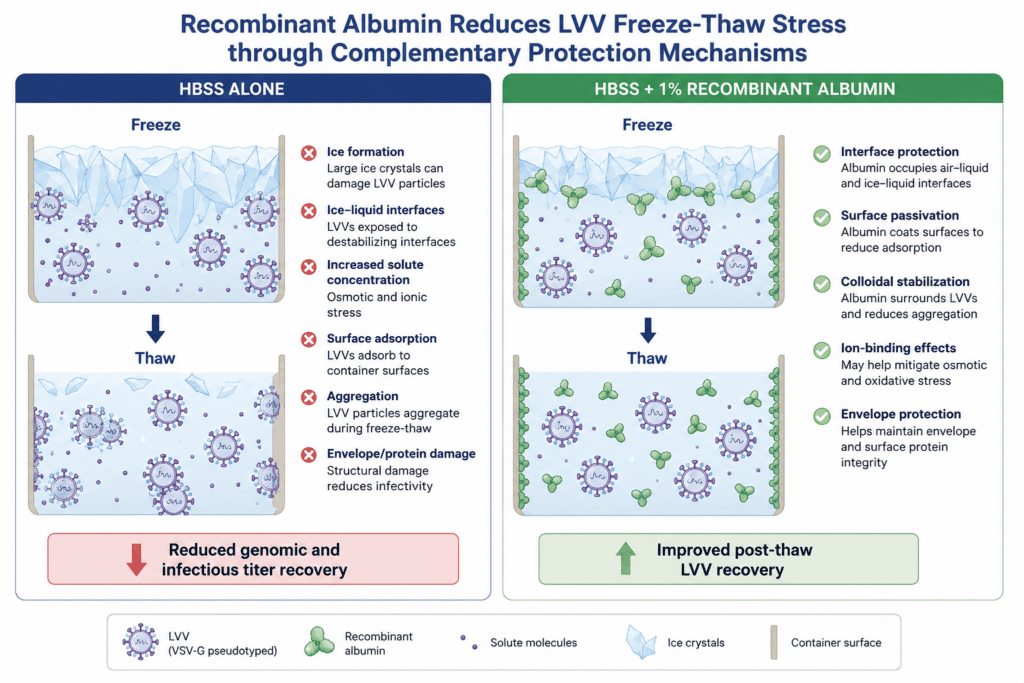
Cryopreservation at -80 °C is commonly used to avoid infectious titer loss associated with LVV thermal instability at room temperature or 2–8 °C. However, suboptimal cryopreservation can also reduce infectious LVV titer (Kumru et al., 2018; Bandeira et al., 2012). During freezing, ice crystal formation can cause mechanical damage to virus particles compromising infectivity. Moreover, water is preferentially incorporated into ice, increasing the solute concentration of the unfrozen liquid fraction and exposing biological particles to osmotic and ionic stress (Mazur et al., 1983). During thawing, prolonged exposure to non-frozen or partially frozen conditions may further contribute to LVV instability, particularly at larger processing volumes where thawing is slower and ice-liquid interfacial exposure, cryoconcentration, and recrystallization effects can be prolonged (Singh, 2009; Puri et al., 2015).
To minimize infectious titer loss during cryopreservation, LVV preparations are often formulated with cryoprotectant excipients. Envelope virus stability is strongly influenced by formulation composition, excipient selection, and storage temperature, making stabilizer selection central to preserving viral potency during storage and handling (Brandau et al., 2003; Kumru et al., 2018).
Disaccharides such as sucrose or trehalose are widely used because they support vitrification, replace water in hydrogen-bonding networks, and limit ice crystal growth that can damage viral particles (Hansen et al., 2015; Zhai et al., 2004; Pastorino et al., 2015; Murray et al., 2024). Consistent with this approach, formulation studies in enveloped viral vectors such as VSV and flaviviruses have shown that sugar-containing formulations can improve functional titer stability under freeze-thaw and temperature stress conditions (Khan et al., 2024; Wiggan et al, 2011). These stabilizing effects are important, but disaccharides alone do not address every mechanism of titer loss in enveloped viruses. LVVs and related enveloped viral vectors may also lose activity through surface adsorption, aggregation, exposure to ice-liquid interfaces, and osmotic stress (Kumru et al., 2018; Perry et al., 2024).
To address these additional stress mechanisms, human serum albumin (HSA) has been used in viral vector and live-virus vaccine formulations (Bandiera et al., 2012; Carmo et al., 2009; Wiggan et al., 2011; Eilts et al., 2023). Albumin can adsorb at air-liquid
interfaces and interact with ice-associated interfaces during freezing (Lu et al., 1999; Twomey et al., 2013). It can also reduce surface adsorption through sacrificial coating (Kumru et al., 2018; Bandeira et al., 2012), mitigate aggregation through colloidal and membrane-associated stabilization (Finn et al., 2012; Thakur et al., 2014; Przybyłek et al., 2024), and bind metals or participate in colloid-ion effects that may contribute to protection against oxidative or osmotic stress (Taverna et al., 2013; Bailey-Schmidt et al., 2026). These mechanisms are distinct from the water-replacement, vitrification, and membrane-stabilizing mechanisms associated with disaccharides such as trehalose and sucrose (Leslie et al., 1995; Murray et al., 2024), supporting the hypothesis that albumin and sugars may provide complementary protection in enveloped virus cryopreservation (Kumru et al., 2018; Hansen et al., 2015; Wiggan et al., 2011). This complementary effect is also supported by prior InVitria work in T cell, MSC, and iPSC cryopreservation (Hamann et al., 2025a; Hamann et al., 2025b; Stathos et al., 2025), where recombinant
albumin was added to Cryostor formulations that contain sucrose according to the product safety data sheet (SDS) (BioLife Solutions, Inc., 2019).
Historically, formulating with plasma-derived HSA has raised safety, regulatory and consistency concerns because it is sourced from human plasma. Virus and viral vector manufacturing literature has also emphasized the value of chemically defined media and excipients to reduce variability and reliance on undefined biological raw materials (Alfano et al., 2021). Optibumin 25 is a recombinant human serum albumin (rHSA) produced in an animal-free expression system and was developed to provide albumin functionality without reliance on human- or animal-derived raw materials. Recombinant albumin has also been described as a stabilizing excipient in live viral formulations, including recombinant vesicular stomatitis virus-based vaccine formulations (Burke & Volkin, 2001). InVitria’s recombinant albumin also has precedent in the formulation Merck’s ERVEBO Ebola Zaire vaccine, a live recombinant vesicular stomatitis virus (rVSV)-based enveloped viral vaccine in which where recombinant albumin is used as an excipient (European Medicines Agency, 2019; U.S. Food and Drug Administration, 2026; Quinn, 2020).
To build on this precedent, we evaluated the effect of Optibumin recombinant albumin on the cryopreservation of VSV-G-pseudotyped LVVs as a model relevant to in vivo CAR-T therapy final formulation.
RESULTS AND DISCUSSION
To evaluate the effect of recombinant albumin on LVV cryopreservation, purified GFP- expressing VSV-G-pseudotyped lentivirus was diluted in HBSS to a final volume of 50 mL and frozen at -80 °C overnight with or without 1% (m/v) Optibumin 25. After 24 hours, samples were held at room temperature until just thawed, approximately 2 hours, and genomic and infectious titers were measured immediately. A freshly prepared sample that had not been frozen and thawed was analyzed in parallel as a control (Figure 1).
Freeze-thaw stress significantly reduced post-thaw genomic titer in the HBSS-only condition, with only approximately 40% of the genomic titer retained relative to the unfrozen control. In contrast, the formulation containing 1% Optibumin maintained genomic titer at a level comparable to the unfrozen control under the conditions tested.
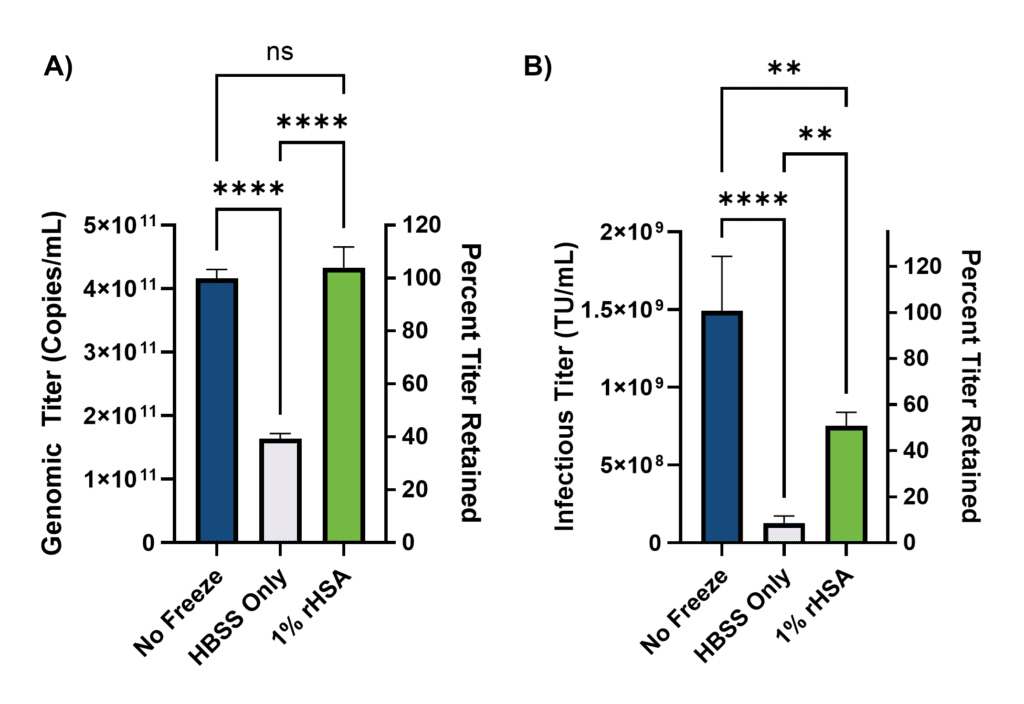
Infectious titer results followed the same overall trend. Only about 10% of the infectious titer was retained in the HBSS-only condition after one freeze-thaw cycle. However, the sample formulated with 1% Optibumin retained approximately 50% of the infectious titer.
Although infectious titer was still reduced relative to the never frozen control, the addition of Optibumin produced an approximately fivefold increase in retained infectious titer compared to HBSS alone.
These data indicate that recombinant albumin can reduce both genomic and infectious LVV titer losses during freeze-thaw processing. The ratio of infectious to genomic titer recovery of between 0.1 to 1% is consistent with reported values (Stibbs et al., 2024) and reflects the sensitivity of enveloped viral infectivity to membrane integrity and surface-protein function. A particle may remain detectable by genomic methods while losing infectivity if the envelope or fusion machinery is damaged.
These cryopreservation results complement previous InVitria work showing that pre-coating 0.2-micron PES sterile filters with 1% Optibumin improved LVV titer recovery during filtration (Stathos et al., 2026). Together, the datasets support the evaluation of recombinant albumin across multiple downstream processing steps where LVV particles are exposed to interfaces, shear, and formulation stress. Formulating LVV preparations with Optibumin prior to sterile filtration and using the same Optibumin containing formulation for cryopreservation may provide a practical and effective strategy to reduce cumulative titer loss during multiple steps in LVV manufacturing.
CONCLUSION
Losses of lentiviral titer during cryopreservation can be substantial in industrial downstream processing workflows. In this study, the addition of 1% (m/v) Optibumin recombinant HSA significantly reduced freeze-thaw-associated LVV titer loss in a simple HBSS-based formulation. Optibumin maintained genomic titer relative to the unfrozen control and increased retained infectious titer by approximately fivefold compared with HBSS alone. These findings support recombinant albumin as a cryoprotective excipient for further LVV formulation development. Because albumin acts through mechanisms that are distinct from and complementary to common disaccharide cryoprotectants, future formulation work should evaluate recombinant albumin in combination with sugars, optimized buffers, and controlled freeze-thaw conditions. The animal-origin-free production system and prior use of recombinant albumin as an excipient in an enveloped viral vaccine support further evaluation of recombinant albumin as a stabilizing excipient in LVV final-formulation strategies for ex vivo and in vivo cell and gene therapy
applications.
MATERIALS AND METHODS
Cryopreservation
Aliquots of purified GFP lentivirus samples (VectorBuilder®, LVMP(VB010000-9492agg)) at 1.00 × 10⁹ TU/mL were diluted in Hanks’ balanced salt solution with or without 1% (m/v) Optibumin 25 to a final volume of 50 mL (2.5 x 10⁵ TU/mL) and frozen at -80 °C overnight. The next day, the samples were held at room temperature until just thawed, approximately 2 hours, at which point genomic and infectious titer were measured.
Genomic Titer Quantitation
Lentiviral genomic titer was measured from viral supernatants. Viral RNA was extracted using the NucleoSpin® RNA Virus Kit (Takara Bio, #740956). Extracted RNA was treated with DNase I to remove any residual plasmid DNA. Purified viral RNA was reverse transcribed and amplified using the Lenti-X® qRT-PCR Titration Kit (Takara Bio, #631236) for quantification using SYBR® Green (Thermo Fisher Scientific) on the QuantStudio™ 3 System (Applied Biosystems, a Thermo Fisher brand). Samples were run in serial dilutions to determine threshold cycle (Ct) values. Ct values were fit to a standard curve of control template RNA with known copy numbers and used to calculate copies per mL. Dilutions outside of the standard curve, or with multiple melt curve peaks, were excluded from analysis.
Infectious Titer Quantitation
HT-1080 cells were seeded at 7,000 cells per well in a 96-well plate in DMEM with 10% FBS and returned to the incubator to allow adhesion. While the cells were adhering, filtered lentivirus samples were serially diluted in DMEM with 10% FBS supplemented with Synperonic® F108 (Croda International). Four hours after plating the cells, the media was exchanged with the diluted virus samples, and the cells were spinoculated at 900 x g for 30 minutes at room temperature before being returned to the incubator. Sixteen hours later, the media was replaced with fresh DMEM with 10% FBS and the cells were monitored for GFP expression using an Incucyte® SX5 live cell imaging system. At 72 hours post-transduction, the percentage of GFP positive cells was recorded. Virus dilutions for which the unfrozen control sample had GFP expression within the linear range of the assay (2.5% to 20% GFP positive) were used to compute the infectious titer using the following equation:
Titer=(F*C/V)*D
Where
F = frequency of GFP+ cells (%GFP-positive cells/100)
C = cell number per well at transduction (7,000 cells)
V = volume per well in mL
D = lentivirus dilution factor
Featured Solution
Optibumin 25 – Recombinant Human Serum Albumin, 25% Solution – Animal-Origin-Free, GMP-Produced
Optibumin 25 is a recombinant human serum albumin for defined biomanufacturing workflows. In this application note, 1% Optibumin 25 improved lentiviral vector recovery after freeze-thaw stress, maintaining genomic titer near unfrozen control levels and increasing retained infectious titer by approximately fivefold compared with HBSS alone.
Optibumin 25 provides an animal-origin-free albumin option for LVV formulation development, especially where preserving infectious titer during storage, handling, and downstream processing is critical.
Ready to try Optibumin 25?
Get a free evaluation sample or request a quote for your project.
Frequently Asked Questions (FAQs)
What problem does this application note address?
This application note addresses lentiviral vector titer loss during freeze-thaw handling. LVVs are fragile enveloped viral vectors, and infectious titer can decline during storage, handling, and downstream processing.
Why is freeze-thaw stress a problem for lentiviral vectors?
Freeze-thaw stress can expose LVVs to ice formation, osmotic stress, ice-liquid interfaces, surface adsorption, aggregation, and envelope or surface-protein damage. These stresses can reduce infectious titer even when genomic material remains detectable.
What was tested in this study?
Purified VSV-G-pseudotyped GFP lentivirus was frozen overnight at -80 °C in Hanks’ balanced salt solution (HBSS) with or without 1% Optibumin® 25 recombinant human serum albumin. A never-frozen sample was included as a control.
What effect did Optibumin 25 have on genomic titer?
Under the conditions tested, 1% Optibumin 25 maintained genomic titer near the level of the unfrozen control, while the HBSS-only condition showed substantial genomic titer loss after freeze-thaw.
What effect did Optibumin 25 have on infectious titer?
The HBSS-only condition retained about 10% of infectious titer after freeze-thaw. The formulation containing 1% Optibumin 25 retained approximately 50%, representing about a fivefold improvement compared with HBSS alone.
How may recombinant albumin help protect LVVs during freeze-thaw?
Recombinant albumin may help protect LVVs by occupying air-liquid and ice-liquid interfaces, passivating container surfaces, reducing aggregation, buffering ion-related stress, and helping maintain envelope and surface-protein integrity.
Is Optibumin 25 replacing sucrose or trehalose in LVV cryopreservation?
Not necessarily. The application note positions albumin as complementary to common disaccharide cryoprotectants such as sucrose or trehalose. Future formulation work should evaluate recombinant albumin in combination with sugars, optimized buffers, and controlled freeze-thaw conditions.
Why use recombinant albumin instead of plasma-derived HSA?
Optibumin 25 is recombinant and animal-origin-free, avoiding reliance on human- or animal-derived raw materials. This supports more defined formulation development and reduces concerns associated with plasma-derived albumin variability.
Is this result specific to one LVV model?
Yes. This study used purified VSV-G-pseudotyped GFP lentivirus in an HBSS-based formulation. The results support further evaluation of recombinant albumin in LVV and other enveloped viral vector formulations, but formulation-specific testing is still needed.
Where could Optibumin 25 fit into an LVV workflow?
Optibumin 25 may be evaluated in LVV formulation steps where particles are exposed to freeze-thaw, interfaces, adsorption, and downstream processing stress. The application note suggests potential use in final formulation strategies for ex vivo and in vivo cell and gene therapy applications.
The following content is gated. Please, subscribe to open access to it.
Footnotes
REFERENCES
- Alfano, R., Pennybaker, A., & Pezoa, S. A. (2021). Recent advances of chemical definition of cell culture media and excipients for virus and viral vector manufacturing: A review. Journal of Bioprocessing & Biotechniques, 11(2), Article 482.
https://www.hilarispublisher.com/open-access/recent-advances-of-chemical-definition-of-cell-culture-media-and-excipients-for-virus-and-viral-vector-manufacturing-a-review-69449.html - Bailey-Schmidt, T., Saunders, C. V., George, C. E., Scorer, T. G., McCallum, L. M. R., & Madgett, T. E. (2026). Serum-derived albumin as a cryoprotective agent for the long-term storage of red blood cells: A preliminary examination. Transfusion, 66(Suppl. 1), S310–S320. https://doi.org/10.1111/trf.70192
- Bandeira, V., Peixoto, C., Rodrigues, A. F., Cruz, P. E., Alves, P. M., Coroadinha, A. S., & Carrondo, M. J. T. (2012). Downstream processing of lentiviral vectors: Releasing bottlenecks. Human Gene Therapy Methods, 23(4), 255–263.
https://doi.org/10.1089/hgtb.2012.059 - BioLife Solutions, Inc. (2019). CryoStor® CS2; CS5; CS10 safety data sheet. BioLife Solutions. https://www.biolifesolutions.com/wp-content/uploads/2022/11/6035_01-CryoStor-CS2-CS5-CS10-Safety-Data-Sheet-EU.pdf
- Brandau, D. T., Jones, L. S., Wiethoff, C. M., Rexroad, J., & Middaugh, C. R. (2003). Thermal stability of vaccines. Journal of Pharmaceutical Sciences, 92(2), 218–231. https://doi.org/10.1002/jps.10296
- Burke, C. W., & Volkin, D. B. (2001). Stabilized viral formulations (U.S. Patent No. 6,210,683 B1). U.S. Patent and Trademark Office. https://patents.google.com/patent/US6210683B1/en
- Carmo, M., Alves, A., Rodrigues, A. F., Coroadinha, A. S., Carrondo, M. J. T., Alves, P. M., & Cruz, P. E. (2009). Stabilization of gammaretroviral and lentiviral vectors: From production to gene transfer. The Journal of Gene Medicine, 11(8), 670–678. https://doi.org/10.1002/jgm.135
- Comisel, R. M., Faulkner, P., Butler, M., & Gagnon, P. (2021). Lentiviral vector bioprocess economics for cell and gene therapy commercialization. Biochemical Engineering Journal, 168, Article 107868. https://doi.org/10.1016/j.bej.2020.107868
- Eilts, F., Harsy, Y. M. J., Lothert, K., Pagallies, F., Amann, R., & Wolff, M. W. (2023). An investigation of excipients for a stable Orf viral vector formulation. Virus Research, 336, Article 199213. https://doi.org/10.1016/j.virusres.2023.199213
- European Medicines Agency. (2019). Ervebo: Ebola Zaire vaccine assessment report (EMA/606159/2019). https://www.ema.europa.eu/en/medicines/human/EPAR/ervebo
- Finn, T. E., Nunez, A. C., Sunde, M., & Easterbrook-Smith, S. B. (2012). Serum albumin prevents protein aggregation and amyloid formation and retains chaperone-like activity in the presence of physiological ligands. Journal of Biological Chemistry, 287(25), 21530–21540. https://doi.org/10.1074/jbc.M112.372961
- Hamann, A., & Stathos, M. (2025a). Enhanced cryopreservation of T cells using Optibumin®, recombinant human serum albumin (rHSA) [Application note]. InVitria, Inc. https://invitria.com/resources/enhanced-cryopreservation-of-t-cells-using-optibumin-rhsa/
- Hamann, A., & Stathos, M. (2025b). Low-DMSO cryopreservation of MSCs with Optibumin 25 recombinant albumin [Application note]. InVitria, Inc. https://invitria.com/resources/low-dmso-cryopreservation-of-mscs-with-optibumin-25-recombinant-albumin/
- Hansen, L. J. J., Daoussi, R., Vervaet, C., Remon, J.-P., & De Beer, T. R. M. (2015). Freeze-drying of live virus vaccines: A review. Vaccine, 33(42), 5507–5519. https://doi.org/10.1016/j.vaccine.2015.08.085
- Khan, M. D. F. H., Wagner, C. E., & Kamen, A. A. (2024). Development of long-term stability of enveloped rVSV viral vector expressing SARS-CoV-2 antigen using a DOE-guided approach. Vaccines, 12(11), Article 1240. https://doi.org/10.3390/vaccines12111240
- Kumru, O. S., Wang, Y., Gombotz, C. W. R., Kelley-Clarke, B., Cieplak, W., Kim, T., Joshi, S. B., & Volkin, D. B. (2018). Physical characterization and stabilization of a lentiviral vector against adsorption and freeze-thaw. Journal of Pharmaceutical Sciences, 107(11), 2764–2774. https://doi.org/10.1016/j.xphs.2018.07.010
- Leslie, S. B., Israeli, E., Lighthart, B., Crowe, J. H., & Crowe, L. M. (1995). Trehalose and sucrose protect both membranes and proteins in intact bacteria during drying. Applied and Environmental Microbiology, 61(10), 3592–3597. https://doi.org/10.1128/aem.61.10.3592-3597.1995
- Lu, J. R., Su, T. J., & Penfold, J. (1999). Adsorption of serum albumins at the air/water interface. Langmuir, 15(20), 6975–6983. https://doi.org/10.1021/la990131h
- Luostarinen, A., Kailaanmäki, A., Turkki, V., Köylijärvi, M., Käyhty, P., Leinonen, H., Albers-Skirdenko, V., Lipponen, E., Ylä-Herttuala, S., Kaartinen, T., Lesch, H. P., & Kekarainen, T. (2024). Optimizing lentiviral vector formulation conditions for efficient ex vivo transduction of primary human T cells in chimeric antigen receptor T-cell manufacturing. Cytotherapy, 26(10), 1084–1094. https://doi.org/10.1016/j.jcyt.2024.04.002
- Martínez-Molina, E., Chocarro-Wrona, C., Martínez-Moreno, D., Marchal, J. A., & Boulaiz, H. (2020). Large-scale production of lentiviral vectors: Current perspectives and challenges. Pharmaceutics, 12(11), Article 1051. https://doi.org/10.3390/pharmaceutics12111051
- Mazur, P., & Rigopoulos, N. (1983). Contributions of unfrozen fraction and of salt concentration to the survival of slowly frozen human erythrocytes: Influence of warming rate. Cryobiology, 20(3), 274–289. https://doi.org/10.1016/0011-2240(83)90016-0
- Murray, A., Kilbride, P., & Gibson, M. I. (2024). Trehalose in cryopreservation: Applications, mechanisms and intracellular delivery opportunities. RSC Medicinal Chemistry, 15, 2980–2995. https://doi.org/10.1039/D4MD00174E
- Pastorino, B., Baronti, C., Gould, E. A., Charrel, R. N., & de Lamballerie, X. (2015). Effect of chemical stabilizers on the thermostability and Infectivity of a representative panel of freeze dried viruses. PLOS ONE, 10(4), Article e0118963. https://doi.org/10.1371/journal.pone.0118963
- Perry, C., Mujahid, N., Takeuchi, Y., & Rayat, A. C. M. E. (2024). Insights into product and process related challenges of lentiviral vector bioprocessing. Biotechnology and Bioengineering, 121(8), 2466–2481. https://doi.org/10.1002/bit.28498
- Przybyłek, M., Bełdowski, P., Ledziński, D., Lutowski, Z., Mazurkiewicz, A., Raczyński, P., Dedinaite, A., & Claesson, P. M. (2024). Molecular insights into the interactions between human serum albumin and phospholipid membranes. Applied Sciences, 14(24), Article 11753. https://doi.org/10.3390/app142411753
- Puri, M., Morar-Mitrica, S., Crotts, G., & Nesta, D. (2015). Evaluating freeze-thaw processes in biopharmaceutical development: Small-scale study designs. BioProcess International, 13(1), 34–45. https://www.bioprocessintl.com/fill-finish/evaluating-freeze-thaw-processes-in-biopharmaceutical-development-small-scale-study-designs
- Quinn, K. S. (2020). Novel or not? Our inadvertent journey filing a novel excipient [Webinar presentation]. Merck & Co.; IPEC-Americas Excipient World Webinar Series. https://education.ipecamericas.org/courses/30181
- Singh, S. K., Kolhe, P., Wang, W., & Nema, S. (2009). Large-scale freezing of biologics: A practitioner’s review, part 2: Practical advice. BioProcess International, 7(10), 34–42. https://www.bioprocessintl.com/fill-finish/large-scale-freezing-of-biologics
- Stathos, M. (2025). Improved iPSC cryopreservation with Optibumin 25 [Application note]. InVitria, Inc. https://invitria.com/resources/improved-ipsc-cryopreservation-with-optibumin-25/
- Stathos, M., Michaels, W., & Weber, J. (2026). Preserving infectious lentivirus titer by pre-coating sterile filters with recombinant albumin [Application note]. InVitria, Inc. https://invitria.com/resources/preserving-lentiviral-titer-during-sterile-filtration-using-recombinant-albumin/
- Stibbs, H. H., Lendon, K., McDonald, D., McLachlan, R., Tapping, R. I., & Schaffer, D. V. (2024). Lentiviral vector adsorption and recovery during downstream processing: Mechanisms and mitigation strategies. Molecular Therapy: Methods & Clinical Development, 32, 101209. https://doi.org/10.1016/j.omtm.2024.101209
- Taverna, M., Marie, A.-L., Mira, J.-P., & Guidet, B. (2013). Specific antioxidant properties of human serum albumin. Annals of Intensive Care, 3, Article 4. https://doi.org/10.1186/2110-5820-3-4
- Thakur, R., Das, A., & Chakraborty, A. (2014). Interaction of human serum albumin with liposomes of saturated and unsaturated lipids with different phase transition temperatures: A spectroscopic investigation by membrane probe PRODAN. RSC Advances, 4, 14335–14347. https://doi.org/10.1039/C4RA01214C
- Twomey, A., Less, R., Kurata, K., Takamatsu, H., & Aksan, A. (2013). In situ spectroscopic quantification of protein-ice interactions. The Journal of Physical Chemistry B, 117(26), 7889–7897. https://doi.org/10.1021/jp403267x
- U.S. Food and Drug Administration. (2026). Package insert: ERVEBO® (Ebola Zaire Vaccine, Live), injectable suspension, for intramuscular use. Merck Sharp & Dohme LLC. https://www.fda.gov/files/vaccines%2C%20blood%20%26%20biologics/published/Package-Insert-ERVEBO_1.pdf
- Valkama, A. J., Oruetxebarria, I., Lipponen, E. M., Leinonen, H. M., Käyhty, P., Hynynen, H., Turkki, V., Malinen, J., Miinalainen, T., Heikura, T., Parker, N. R., Ylä-Herttuala, S., & Lesch, H. P. (2020). Development of large-scale downstream processing for lentiviral vectors. Molecular Therapy: Methods & Clinical Development, 17, 717–730. https://doi.org/10.1016/j.omtm.2020.03.025
- Wiggan, O., Livengood, J. A., Silengo, S. J., Kinney, R. M., Osorio, J. E., Huang, C. Y.-H., & Stinchcomb, D. T. (2011). Novel formulations enhance the thermal stability of live-attenuated flavivirus vaccines. Vaccine, 29(43), 7456–7462. https://doi.org/10.1016/j.vaccine.2011.07.054
- Zhai, S., Hansen, R. K., Taylor, R., Skepper, J. N., Sanches, R., & Slater, N. K. H. (2004). Effect of freezing rates and excipients on the infectivity of a live viral vaccine during lyophilization. Biotechnology Progress, 20(4), 1113–1120.
https://doi.org/10.1021/bp034362x