


Cellastim® S – Recombinant human albumin
Specifically optimized for cell culture media applications
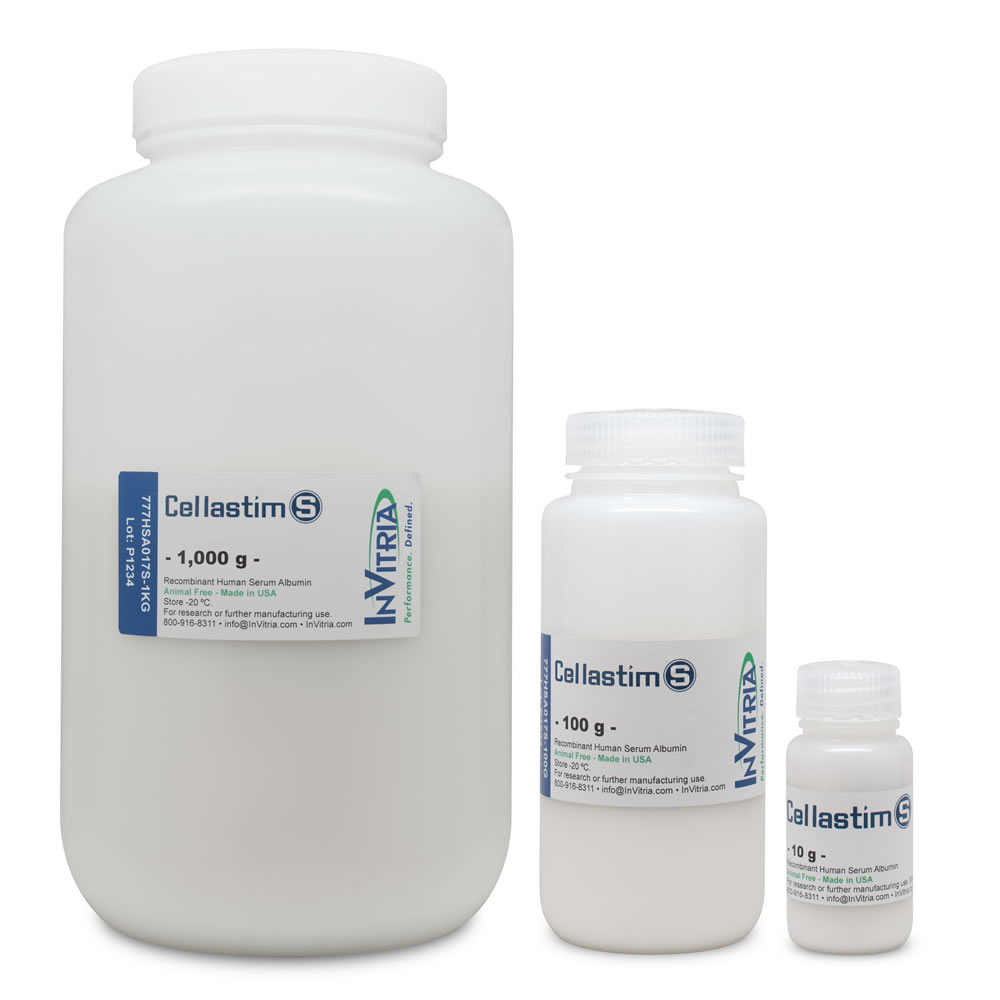

Name | Price | Qty | |
|---|---|---|---|
$548.00
|
|||
$4,349.00
|
Product Description
Cellastim® S is InVitria's cell culture-grade recombinant human serum albumin (rHSA), supplied as a chemically defined, animal-origin-free lyophilized powder for serum-free cell culture media supplementation. Produced using InVitria's ExpressTec expression platform at an ISO 9001:2015-certified, cGMP-compliant facility in Junction City, Kansas, Cellastim S is the recombinant, animal-free replacement for bovine serum albumin (BSA) and plasma-derived human serum albumin in serum-free cell culture applications.
Cellastim S is widely cited in peer-reviewed cell culture research — including publications in Nature Methods, Nature Aging, Nature Protocols, Nature Communications, and Science Advances — across applications including cardiomyocyte generation from pluripotent stem cells, iPSC and MSC expansion, T cell and NK cell culture, CHO and HEK293 bioproduction, and serum-free media formulation. Lot-to-lot consistency and cell culture performance testing on every lot provide the reproducibility required for both research and GMP biomanufacturing workflows.
Cellastim S supports CHO, HEK293, VERO, iPSC, MSC, HSC, CD34+, and immune cell (T cell, NK cell, Treg, TIL) expansion workflows, serum-free media formulation, and cell cryopreservation applications. For rHSA applications outside cell culture — including excipient use in final formulation of injectable biologics, drug conjugation, and cell and gene therapy manufacturing — see Exbumin or Optibumin 25.
Ready to try Cellastim S?
Advantages
Validated in Peer-Reviewed Cell Culture Research
- Cited across peer-reviewed publications in Nature Methods, Nature Aging, Nature Protocols, Nature Communications, Science Advances, and other peer-reviewed journals
- Validated across diverse cell systems including CHO, HEK293, VERO production cell lines, iPSC, MSC, HSC, CD34+ stem cells, and T cell, NK cell, Treg, and TIL immune cell expansion workflows
- Referenced in foundational protocols for cardiomyocyte generation from pluripotent stem cells, hair-bearing skin organoid generation, and cardiac tissue engineering
- Every lot cell culture performance–tested in addition to chemical specifications — providing application-level reproducibility rather than specification-only quality
Animal-Origin-Free and Blood-Free Composition
- 100% animal-origin-free and blood-free — eliminates TSE/BSE risk of bovine serum albumin (BSA) and adventitious agent risk of plasma-derived HSA
- Chemically defined, recombinant expression — eliminates the undefined lipid, fatty acid, and minor protein content of BSA and the stabilizer content of plasma HSA
- Raw materials, production host, manufacturing equipment, and product-contact packaging are all free of animal-derived components
- Supports animal-free regulatory pathways aligned with FDA and EMA guidance for cell therapy, gene therapy, and vaccine programs
Defined Composition and Lot-to-Lot Consistency
- Purity ≥96.0% — cell culture grade appropriate for serum-free media supplementation
- Endotoxin level ≤1.0 EU/mg — appropriate for cell culture and research applications
- No added preservatives, no added stabilizers — unlike plasma-derived HSA, which requires sodium octanoate and N-acetyl tryptophan for pasteurization
- Lot-to-lot consistency enabled by recombinant expression — eliminates the herd, seasonal, and donor-pool variability inherent to BSA and plasma HSA
Supply Chain Reliability and Manufacturing Control
- End-to-end vertically integrated US-based manufacturing at InVitria's ISO 9001:2015-certified, cGMP-compliant facility in Junction City, Kansas
- Scalable production capacity independent of cattle supply or human blood donation volumes
- Available directly from InVitria and through major life science distributors including Thermo Fisher Scientific (cat. 50-135-4695), VWR, and MilliporeSigma
- 4-year shelf life when stored at –20°C
Applications
Stem Cell Expansion and Pluripotent Stem Cell Culture Cellastim S supports long-term expansion and differentiation of induced pluripotent stem cells (iPSC), mesenchymal stem cells (MSC), hematopoietic stem cells (HSC), and CD34+ stem cell workflows in chemically defined, serum-free media. Cellastim S has been cited in foundational stem cell methods including chemically defined cardiomyocyte generation from pluripotent stem cells (Nature Methods) and hair-bearing skin organoid generation from human pluripotent stem cells (Nature Protocols). Its chemically defined, animal-origin-free composition supports the reproducibility required for stem cell research, differentiation protocol development, and regenerative medicine applications.
Immune Cell Expansion and Cell Culture Cellastim S is used in T cell, NK cell, regulatory T cell (Treg), and tumor-infiltrating lymphocyte (TIL) expansion workflows, providing a chemically defined, animal-origin-free albumin source for serum-free immune cell culture. Its recombinant lot-to-lot consistency eliminates the donor variability of plasma-derived HSA and the undefined composition of bovine serum albumin (BSA), supporting reproducible cell expansion across research, process development, and cell therapy upstream workflows.
Production Cell Line and Bioproduction Workflows Cellastim S supports CHO, HEK293, and VERO production cell lines for biologic, vaccine, and recombinant protein manufacturing. It enhances cell productivity and adaptation in serum-free and chemically defined culture systems, eliminating the adventitious agent risk and lot variability of animal-derived supplements. Cellastim S has been cited in research on CtIP-Cas9 enhanced transgene integration (Nature Communications) and SARS-CoV-2 spike protein nanobody development (Scientific Reports).
Vaccine Production and Virus Propagation Cellastim S supports VERO cell-based vaccine manufacturing and virus propagation workflows, providing a chemically defined, animal-origin-free alternative to bovine serum albumin and plasma-derived HSA in vaccine production cell culture. Its lot-to-lot consistency and recombinant expression support the regulatory expectations of animal-free manufacturing for modern vaccine programs.
Cell Cryopreservation Cellastim S is used in cell cryopreservation formulations across iPSC, MSC, immune cell, and production cell line workflows. Its chemically defined, animal-origin-free composition and recombinant lot-to-lot consistency provide the reproducibility required for cryopreservation protocols across research, process development, and cell banking applications.
Serum-Free Media Formulation Cellastim S serves as the albumin component in chemically defined, serum-free cell culture media formulations across research and biomanufacturing applications. Its defined composition, recombinant consistency, and cell culture performance testing on every lot support the development of reproducible serum-free formulations for diverse cell types and applications. For custom serum-free media development support, see InVitria's media formulation services.
Cellastim S Technical Specifications
Key specifications for Cellastim S as supplied — including purity, endotoxin, formulation, storage, and manufacturing standards. Full Certificate of Analysis available upon request.| Specification | Details |
|---|---|
| Product Name | Cellastim® S |
| Brand | InVitria® |
| Catalog Number | 777HSA017S |
| Protein | Recombinant Human Serum Albumin (rHSA) |
| Class | Serum Protein / Albumin — Excipient Grade |
| Synonyms | rHSA, HSA, ALB, Albumin, Human Albumin, SA, rHA |
| Expression System | Recombinant, rice-based expression system |
| Molecular Weight | ~66.5 kDa |
| Purity | > 96.0% |
| Endotoxin Level | ≤ 1.000 EU/mg |
| Formulation | Lyophilized powder |
| Concentration | Reconstitute to working stock solution, 10-20% w/v recommended |
| Appearance | White to off-white lyophilized powder |
| Carrier Protein / Stabilizer | None (no additives or preservatives) |
| Sterility | Powder; sterile filter after reconstitution |
| Packaging | 10 g, 100 g, + scale packaging |
| Storage Conditions | –20 °C |
| Shelf Life | 4 years |
| Animal-Origin-Free | Yes |
| Production Standard | ISO 9001:2015, cGMP-compliant facility |
| Country of Origin | USA (Junction City, KS) |
Why Select Cellastim S Over Plasma-Derived Albumin or BSA ?
| Key Attribute | Cellastim S (rHSA) | Bovine Serum Albumin (BSA) | Plasma-derived Albumin (pHSA) |
|---|---|---|---|
| SOURCE AND COMPOSITION | |||
| Species | Recombinant human | Bovine (cow) | Human (plasma pool) |
| Source material | Rice grain recombinant expression (ExpressTec) | Cattle blood (slaughterhouse byproduct) | Human blood plasma donations |
| Defined molecular composition | ✅ Yes — defined recombinant protein | ❌ Undefined lipid, fatty acid, and minor protein content | ❌ Variable stabilizer and fatty acid content |
| Human sequence (native receptor compatibility) | ✅ Yes | ❌ No — species mismatch in human cell culture | ✅ Yes |
| SAFETY PROFILE | |||
| Recombinant production | ✅ Yes | ❌ No (animal-derived) | ❌ No (plasma-derived) |
| Animal-origin-free | ✅ Yes | ❌ Bovine-derived | ❌ Blood-derived |
| Blood-free | ✅ Yes | ❌ Blood-derived | ❌ Blood-derived |
| Free of adventitious agent risk | ✅ Yes | ❌ Adventitious agent risk present | ❌ Adventitious agent risk present |
| No donor or herd variability | ✅ Yes | ❌ Herd and seasonal variability | ❌ Donor-pool variability |
| TSE/BSE risk | ✅ None (no animal source) | ❌ Present (bovine source) | ⚠️ Depends on donor screening |
| FORMULATION ADDITIVES | |||
| Added preservatives | ✅ No | ❌ Typically contains preservatives, (sodium azide, sodium benzoate, potassium sorbate) | ❌ Typically contains preservatives, (sodium azide, sodium benzoate, potassium sorbate) |
| Added stabilizers | ✅ No | ❌ Typically contains stabilizers (sodium octanoate, N-acetyl tryptophan) | ❌ Typically contains stabilizers (sodium octanoate, N-acetyl tryptophan) |
| LOT-TO-LOT CONSISTENCY | |||
| Consistent lot-to-lot performance | ✅ Yes — controlled recombinant production | ❌ Variable — herd and seasonal variability | ❌ Variable — donor-pool variability |
| Performance traceable to a single manufacturing process | ✅ Yes — ExpressTec platform | ❌ Multi-source slaughterhouse byproduct | ❌ Multi-donor plasma pool |
| Supports animal-free and sustainable sourcing mandates | ✅ Yes | ❌ No | ❌ No |
| SUPPLY CHAIN AND SCALABILITY | |||
| Scalable production (metric-ton capacity) | ✅ Yes | ⚠️ Limited by slaughterhouse supply | ❌ Limited by plasma donor supply |
| Supply independent of blood or animal sourcing | ✅ Yes | ❌ Dependent on cattle supply | ❌ Dependent on donor supply |
| Scale-up partnership with customer programs | ✅ Yes — InVitria scales with customer programs from clinical through commercial | ❌ Typically not provided | ❌ Typically not provided |
| Vertically integrated supply chain | ✅ Yes — InVitria owns the complete supply chain | ❌ Multiple intermediaries | ❌ Multiple intermediaries |
| Manufactured in United States | ✅ Yes — Junction City, Kansas | Varies by supplier | Varies by supplier |
| Supports animal-free and sustainable sourcing mandates | ✅ Yes | ❌ No | ❌ No |
| REGULATORY AND DOCUMENTATION SUPPORT | |||
| ISO 9001:2015 certified manufacturing | ✅ Yes | Varies by supplier | Varies by supplier |
| cGMP-compliant QMS (21 CFR 210/211) | ✅ Yes | Varies by supplier | Varies by supplier |
| Animal-Free Statement / Certificate of Origin | ✅ Available | ❌ Not available | ❌ Not applicable |
| Regulatory support package | ✅ Yes — full dossier-quality documentation for IND and BLA submissions | ❌ Limited or supplier-dependent | ❌ Limited or supplier-dependent |
| Technical support for regulatory filings | ✅ Yes — InVitria technical team supports customer regulatory submissions | ❌ Not typically provided | ❌ Not typically provided |
| Full regulatory documentation on request | ✅ Yes | Varies by supplier | Varies by supplier |
Cellastim S Frequently Asked Questions (FAQs)
Product Overview
What Is Cellastim S?
Cellastim S is InVitria's cell culture-grade recombinant human serum albumin (rHSA), supplied as a lyophilized powder for serum-free cell culture media supplementation and cell cryopreservation applications. Produced using InVitria's ExpressTec expression platform at an ISO 9001:2015-certified, cGMP-compliant facility in Junction City, Kansas, Cellastim S is the recombinant, animal-origin-free replacement for bovine serum albumin (BSA) and plasma-derived human serum albumin in serum-free cell culture applications.
What Is Cellastim S Made From?
Cellastim S is produced recombinantly using InVitria's ExpressTec expression platform, a non-mammalian, non-human expression host with no animal-derived, human-derived, or blood-derived materials. Manufacturing is fully animal-origin-free, from raw materials through production equipment to product-contact packaging. Cellastim S contains no added preservatives and no added stabilizers.
Can Cellastim S Replace BSA or Plasma-Derived Albumin in Cell Culture?
Yes. Cellastim S is specifically designed as the recombinant, animal-origin-free replacement for bovine serum albumin (BSA) and plasma-derived human serum albumin in serum-free cell culture media supplementation and cell cryopreservation applications. Unlike BSA, Cellastim S eliminates TSE/BSE risk, donor and lot variability, and the undefined lipid, fatty acid, and minor protein content of bovine-derived albumin. Unlike plasma-derived HSA, Cellastim S eliminates adventitious agent risk and donor pool variability.
Quality and Regulatory
Is Cellastim S cGMP-Manufactured and Animal-Origin-Free?
Yes. InVitria manufactures Cellastim S under a cGMP-compliant Quality Management System (QMS) with respect to 21 CFR Part 210/211 at its ISO 9001:2015-certified facility in Junction City, Kansas, USA. Cellastim S is 100% animal-origin-free — raw materials, production host, manufacturing equipment, and product-contact packaging are all free of animal-derived components.
What Are the Purity and Endotoxin Specifications for Cellastim S?
Cellastim S is supplied as a lyophilized powder with purity ≥96.0% and endotoxin ≤1.0 EU/mg — specifications appropriate for cell culture media supplementation and cell culture research applications.
What Quality Documentation Is Available for Cellastim S?
Cellastim S is supported by a Certificate of Analysis, Safety Data Sheet, Guidelines for Use, Certificate of Origin and Animal-Free / TSE-BSE Statement, ISO 9001 certificate, and cGMP Statement. Additional Quality and Regulatory documentation is available on request — including materials for supplier qualification and animal-free certification.
Does InVitria Provide a Drug Master File (DMF) or Equivalent Regulatory Documentation for Cellastim S?
InVitria provides a product-specific Technical Summary for Cellastim S containing CMC-style documentation — including manufacturing process, raw material controls, characterization data, release specifications, and lot analysis — designed to support customer regulatory submissions globally, including IND, BLA, and comparable filings under FDA, EMA, and other regulatory authorities. Unlike a Drug Master File, the Technical Summary is provided directly to the customer for incorporation into their own regulatory documentation, giving customers full visibility into the CMC information and supporting global filings without being tied to a single regulatory pathway. The Optibumin 25 Technical Summary is supported by per-lot Certificates of Analysis, Animal-Origin-Free / TSE-BSE statements, ISO 9001 certification, cGMP statements, and change notification under defined policies. Contact us to request the Technical Summary.
Does Cellastim S Need to Be Sterile Filtered Before Use?
Cellastim S is supplied as a non-sterile lyophilized powder. Sterile filtration using a low-protein-binding 0.2 µm filter after reconstitution is recommended for any aseptic workflow.
How Does Cellastim S Reduce Regulatory Risk Compared to BSA or Plasma-Derived Albumin?
Replacing animal-derived albumin with a recombinant, animal-origin-free input eliminates TSE/BSE risk, adventitious agent risk, and donor or herd variability. This simplifies raw material risk assessment, supplier qualification, and comparability planning — particularly for cell therapy, gene therapy, and vaccine programs moving toward animal-free manufacturing in alignment with FDA and EMA regulatory guidance.
Selection and Comparison
What Is the Difference Between Cellastim S and Optibumin 25?
Cellastim S is InVitria's cell culture-grade recombinant human serum albumin (rHSA), supplied as a lyophilized powder for serum-free cell culture media supplementation and cell cryopreservation applications. Optibumin 25 is a higher-purity (≥99.0%) liquid rHSA supplied as a 25% (w/v) solution in bottles and closed-system bags, with specifications appropriate for use as an excipient in final formulation of injectable biologics, cell and gene therapy manufacturing, drug conjugation, and related applications where formulation-grade purity and endotoxin specifications are required.
For serum-free cell culture media supplementation and cell cryopreservation applications, Cellastim S is the appropriate product. For use as an excipient in injectable drug product formulations, cell and gene therapy manufacturing, or bioconjugation, Optibumin 25 is the correct product. Contact InVitria to discuss the best option for your specific application.
What Is the Difference Between Cellastim S and Exbumin?
Cellastim S is the cell culture-grade recombinant human serum albumin (rHSA) designed for serum-free cell culture media supplementation and cell cryopreservation applications. Exbumin is the excipient-grade rHSA with documented regulatory precedent in an approved injectable human biologic — it is a formulation component in Merck's ERVEBO Ebola vaccine and is approved as an excipient by the FDA, EMA, and PMDA. Exbumin is supplied as a lyophilized powder.
Choose Cellastim S for cell culture and cryopreservation. Choose Exbumin for use as an excipient in injectable drug product formulations — particularly where regulatory precedent for injectable use is beneficial.
How Is Cellastim S Different From Yeast-Derived Recombinant Albumins?
Yeast-derived recombinant albumins addressed the pathogen risk of plasma HSA but introduced new issues: immunogenic yeast host cell proteins requiring extensive purification, and surfactants like Polysorbate 80 added to prevent processing aggregation. Cellastim S's non-mammalian, non-yeast ExpressTec expression system produces a native-state molecule without these constraints.
Application and Use
What Cell Types Is Cellastim S Used For?
Cellastim S supports CHO, HEK293, and VERO production cell lines, stem cell systems including iPSC, MSC, HSC, and CD34+ cells, and immune cell expansion workflows including T cell, NK cell, regulatory T cell (Treg), and tumor-infiltrating lymphocyte (TIL). It is also used in serum-free cell culture media formulation and cell cryopreservation applications.
What Concentration of Cellastim S Should I Use in Cell Culture Media?
Start in the 0.1–2 g/L range and optimize based on cell type and medium composition. Because Cellastim S is chemically defined with recombinant lot-to-lot consistency, some processes achieve strong performance at lower inclusion levels than the equivalent BSA or plasma-derived HSA concentration.
What Is the Reconstitution Protocol for Cellastim S?
InVitria's reconstitution application note provides a step-by-step protocol to prepare a sterile 10–20% stock solution using gentle mixing and sterile filtration. Avoid vortexing and allow full dissolution at cold temperature to minimize foaming and aggregation. See the Cellastim S Reconstitution Application Note and rHSA Reconstitution Video Protocol for detailed guidance.
Can Cellastim S Be Used for Cell Cryopreservation?
Yes. Cellastim S is widely used in cell cryopreservation formulations across iPSC, MSC, immune cell, and production cell line workflows. Its chemically defined, animal-origin-free composition and recombinant lot-to-lot consistency provide the reproducibility required for research, process development, and cell banking cryopreservation applications.
Is Cellastim S Cited in Peer-Reviewed Research?
Yes. Cellastim S has been cited in peer-reviewed publications across leading scientific journals, including Nature Methods, Nature Aging, Nature Protocols, Nature Communications, Science Advances, and Scientific Reports. Published applications include chemically defined cardiomyocyte generation from pluripotent stem cells, iPSC and MSC expansion, cardiac tissue engineering, hair-bearing skin organoid generation, SARS-CoV-2 nanobody development, and CtIP-Cas9 enhanced transgene integration. See the published research section of this page for specific citations.
Packaging and Ordering
What Packaging Options Are Available for Cellastim S?
Cellastim S is available as a lyophilized powder in 10 g and 100 g formats. Contact InVitria for bulk and custom packaging options to support cell culture media formulation and biomanufacturing programs.
How Can I Order Cellastim S?
Cellastim S is available worldwide through multiple purchasing pathways. Most customers work directly with InVitria for full access to the Cellastim S product portfolio, bulk and commercial-scale supply, favorable volume-tier pricing, faster supply chain turnaround, GMP supply commitments, and regulatory documentation support. Cellastim S is also available through Fisher Scientific, VWR, and the Labviva procurement platform (which integrates with Ariba, Coupa, Oracle, and Jaggaer) for customers whose institutional procurement systems require integrated supplier ordering. European customers can order with direct fulfillment from InVitria's Rotterdam, Netherlands facility. All customers receive the same product, Certificate of Analysis, and technical support regardless of channel. Contact InVitria or request bulk pricing to place an order.
Storage and Handling
How Should Cellastim S Be Stored?
Store lyophilized Cellastim S at –20°C, protected from moisture. Follow the Guidelines for Use for reconstitution, filtration, and storage of prepared stocks. Shelf life is 4 years from date of manufacture. Contact InVitria technical support for application-specific handling guidance.
Peer-Reviewed Research Citing Cellastim S
Cellastim S has been cited in peer-reviewed research across leading scientific journals including Nature Methods, Nature Aging, and Nature Protocols. The publications below represent a selection of this work — from foundational stem cell differentiation protocols to cell therapy, cardiac tissue engineering, and biopharmaceutical research. Each represents an independent validation of Cellastim S's reproducibility in chemically defined cell culture.Related Resources
| Resource Type | Title | Cell Lines | Relevance |
|---|---|---|---|
| Application Note | Cellastim S – Reconstitution Application Note | Mesenchymal Stem Cells, Hematopoetic Stem Cells, T Lymphocyte, HEK293, VERO | Stock preparation protocol for use in cell culture applications. |
| Application Note | rHSA Reconstitution Video Protocol | — | Video walkthrough of rHSA reconstitution. |
| White Paper | Emergence of Blood-Free Recombinant Human Albumin | — | Platform overview of rHSA in upstream, downstream, and formulation applications. |
| White Paper | Cellastim S – Recombinant Human Serum Albumin in the Generation of Functional Cardiomyocytes from Pluripotent Stem Cells | iPSC, ESC | Cellastim S in iPSC/ESC cardiomyocyte differentiation white paper. |
| Poster | Advancing Vaccine Excellence | VERO | Vaccine production infographic featuring Cellastim S. |
| Poster | Cellastim S – Optimizing Antibody Production in Animal-Free Media with the Supplementation of Recombinant Human Albumin | CHO, Hybridoma | Direct CHO and hybridoma performance data across 6 commercial CHO media formulations. |
| Journal Articles (DOI Links) | Utilization of Recombinant Albumins in the Expansion of Human T Lymphocytes | T Lymphocyte | Peer-reviewed publication featuring Cellastim S in T-cell expansion. |
| Journal Articles (DOI Links) | Accurate nanoelectrode recording of human pluripotent cell-derived cardiomyocytes for assaying drugs and modeling disease | iPSC, ESC | Peer-reviewed publication featuring Cellastim S in pluripotent stem cell-derived cardiomyocyte studies. |
| Webinar | GEN Webinar: Why Cell Quality Erodes During Downstream Processing — and How to Prevent It | — | Strategies for downstream cell quality preservation. |
| Webinar | Accelerating Vaccine Development Through Use of Blood-Free Components | — | GEN webinar on blood-free vaccine development. |
| Infographic | Optimizing CAR-T Manufacturing with Defined, AOF Components | T Lymphocyte | How Cellastim S fits in the CAR-T manufacturing workflow. |
| Blog | Beyond Synthetic Surfactants: The Case for Recombinant Human Serum Albumin (rHSA) as an Ideal Alternative to Poloxamer 188 | CHO, T Lymphocyte | Discussion of rHSA mechanisms in CHO cell culture and shear protection. |
| Blog | The "Cheap" Albumin Paradox: The Actuarial Cost of Serum Albumin in Biomanufacturing | CHO, T Lymphocyte | Risk-adjusted cost analysis of plasma HSA in biomanufacturing. |
| Blog | Supply Chain Resilience: The Fragility and Finite Nature of Serum-Derived Raw Materials | — | Macro view on serum-derived raw material supply risks. |
| Blog | Safety and Contamination Risks: The Testing Burden and Persistent Threats | — | Contamination and testing burden of serum-derived materials. |
| Blog | Variability and Failed Lots: The Hidden Quality Control Challenge of Serum & Serum-Derived Products | — | Lot-to-lot variability of plasma HSA vs the consistency of recombinant alternatives. |
| Blog | Consistency Is the New Compliance | — | Regulatory landscape favoring chemically defined, recombinant materials. |